The modern restaurant order stack runs on the internet
A decade ago, a restaurant took orders at the counter and over the phone. Today, orders arrive through first-party online ordering, third-party delivery apps, the phone, and increasingly Voice AI ordering that answers and takes orders automatically. Every one of those channels has one thing in common: it needs an active internet connection to function. That makes connectivity the foundation your entire order volume sits on.
It also means a single point of failure can take down every order channel at once. When the connection drops, the website stops accepting orders, the delivery tablets go offline, and the phones, which now run on VoIP, go silent too. The restaurant is open, the kitchen is ready, and no orders can get in.
What actually breaks during an outage
When the internet fails, the losses stack up across channels. First-party online ordering returns errors or simply will not load. Third-party delivery orders stop flowing to your tablets, and the platforms may mark your location as unavailable. Phone orders fail because the VoIP system is down. Even the POS that ties it all together cannot authorize cards. The dining room might limp along on cash, but the off-premise revenue, often a third or more of a modern restaurant’s sales, evaporates.
The off-premise revenue math
For many restaurants, off-premise orders now make up a third or more of total sales, and at some concepts it is the majority. That shift changes the stakes of an outage. When a third of your revenue depends on channels that only work with a live internet connection, connectivity stops being an IT line item and becomes a direct driver of sales. A location pulling 40 percent of its volume through online and delivery can lose more during a one-hour outage than it spends on backup internet in a year.
33%+
Share of sales from off-premise channels at many restaurants
40%
Online and delivery volume at higher-mix locations
1 hour
A single peak outage can cost more than a year of backup internet
The losses are also concentrated at the worst times. Outages cluster around peak demand, when the local network is most loaded and your order volume is highest. The hour you can least afford to lose is exactly the hour you are most likely to lose it, which is why protecting the order channels is not optional for a high-volume operation.
First-party ordering versus third-party apps
Where your orders come from changes how much an outage hurts. Third-party delivery apps bring volume but take a margin and own the customer relationship, and during an outage they can quietly mark you unavailable. First-party online ordering keeps the margin and the customer data, but it lives entirely on your own connection, so if the site cannot reach your kitchen, the order is simply lost. Either way, the connection is the common dependency. Many operators are pushing customers toward first-party ordering to protect margin, which makes uptime even more important, because there is no app to fall back on when your own channel goes dark. The stronger your direct ordering becomes, the more it depends on a connection that does not drop.
The hidden cost of lost orders
Unlike a slow night, lost online orders do not reschedule themselves. A customer whose order fails moves to the next restaurant on the app and may not come back. Third-party platforms can penalize locations for missed or cancelled orders, hurting your ranking and your standing. And the one-star review that follows a botched online order keeps costing you visibility long after the outage is fixed. The damage outlives the downtime.
Jason Owenby, who operates 20 Jack Brown’s locations, described exactly this before he fixed his connectivity: Friday nights meant outage alerts on Slack, frozen orders, and the team bracing for losses. After putting reliable failover in place, he turned his biggest recurring headache into his easiest win.
The reviews and rankings you do not see coming
The cost of a failed order does not end when the connection comes back. On third-party platforms, missed and cancelled orders can quietly push your location down in the rankings, so you show up less often for the next hungry customer. A frustrated guest leaves a one-star review that sits on your listing for months. And the customer who had a bad experience simply stops ordering. None of this shows up on the night of the outage, which is exactly why it is so easy to underestimate. Protecting uptime is not only about the orders you lose tonight, it is about the visibility and loyalty you keep for every night after.
Why phone orders die too
Operators often assume the phone is a fallback when the internet is down. It is not, because the phone now runs on the internet. Modern VoIP phone systems carry calls over the same connection as everything else, so when the line drops, the phones drop with it. Reservations go unanswered, call-ahead orders fail, and the one channel staff instinctively reach for is gone. Failover keeps the phone system online alongside the order channels, which is why connectivity and phones should be designed as one system, not two.
How to keep order channels online
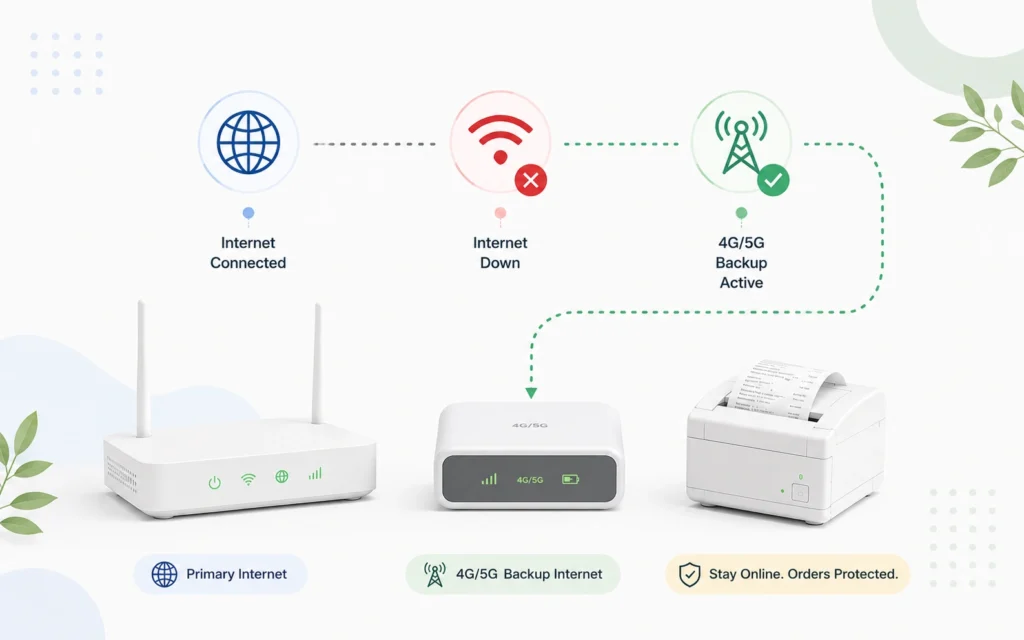
The fix is the same foundation that protects payments: automatic backup and failover internet. A second connection on a separate carrier takes over within seconds of the primary failing, so the website keeps accepting orders, the delivery tablets stay connected, and the phones keep ringing. Paired with a managed network that prioritizes order and payment traffic, your revenue channels stay up while the outage gets resolved in the background.
Where Voice AI fits
As more restaurants add Voice AI and AI ordering to capture phone orders that staff miss during a rush, the stakes for uptime only rise. An AI receptionist that takes orders around the clock is a revenue engine, but only while it is online. Connectivity is what turns these tools from a nice feature into a dependable channel. The automation and the uptime have to be designed together.
Protecting the orders you are currently losing
Most operators underestimate how many orders they lose to brief outages because the losses are invisible, there is no record of the order that never came through. The first step is to stop the leak with failover, then layer in tools that capture more demand. To see how much order revenue your locations are exposed to, get a free cost analysis, or read the complete restaurant connectivity guide for the full picture.
Frequently Asked Questions
Why do online orders fail when the internet goes down?
First-party online ordering, third-party delivery, and VoIP phones all rely on an active internet connection. When the primary connection fails and there is no automatic failover, every one of those order channels goes offline at the same time.
Do third-party delivery apps still work during an internet outage?
No. Delivery platforms send orders to tablets or your POS over the internet. During an outage they cannot reach your location, and they may temporarily mark your store as unavailable, which can also affect your ranking on the app.
Do phone orders work if the internet is down?
Not if you use a VoIP phone system, which most restaurants now do, because VoIP runs over the internet. Automatic failover keeps the phone system online during an outage so you can still take phone orders.
How do restaurants stop losing orders during outages?
By installing automatic backup and failover internet so order channels stay online, and by using a managed network that prioritizes order and payment traffic during the outage.
How much revenue do outages cost a restaurant?
It varies by volume, but off-premise channels often make up a third or more of sales, and those orders are lost permanently during an outage rather than delayed, so even short outages at peak hours are costly.
Stop the leak before the next rush.
See how much order revenue your locations are exposed to with a free cost analysis.

About the author
Gordon Vanderslice
Support Engineer at Vivant
When a customer's internet or phones act up, Gordon tracks down the cause and fixes it, whether that's a failed line or a hard-to-find configuration issue.
Has never met a blinking light he didn't want to investigate.