Phone systems for restaurants have one job during the rush: make sure no call turns into a lost order. When the host is seating a table and the line is five deep, a ringing phone is a choice between the guest in front of you and the takeout order on the line. Most restaurants lose that trade more often than they know.
We compared 7 phone systems for restaurants on 5 weighted technical criteria, from call queues to POS integration. You will also find AI answering, a cost example for a single location and a chain, and a guide to choosing by restaurant type.
How we picked these phone systems
We started with some market research to find the leading phone system brands. Then we rated every system on the same five technical criteria:
| Criterion | Weight | What we checked |
|---|---|---|
| Rush-hour call handling | 30% | Call queues, wait-time announcements, IVR, ring groups, missed-call texts, AI answering |
| Price | 20% | Start price, what is included, and how the price scales across locations |
| Integrations | 20% | POS, online ordering, reservations and CRM |
| Ease of setup | 15% | Time to go live, who configures the system, how easy it is to change call flows |
| Reliability and support | 15% | Uptime SLA, internet failover, and how fast a human answers |
Rush-hour handling has the highest weight because that is when restaurants lose the most calls. A system that is cheap but sends callers to a busy signal on Friday night costs more than it saves.
How we score: each criterion gets a rating from 1 to 5. The final score is the weighted average, shown with its breakdown at the end of each review.
The 7 best restaurant phone systems for 2026
1. Vivant Business Phone System
The best overall restaurant phone system for owners who want to stop managing their own connectivity. Vivant takes a 360° approach: one provider delivers your phone system, internet, dual backup internet, network security and support, all for one monthly price per location. It guarantees 100% uptime in writing, and a Vivant team sets up and manages everything for you. Restaurant groups and chains get the most value from it.
At a glance:
- Best for: busy single locations, multi-location restaurants and franchise groups that want a managed system
- Price: restaurant plans from $350 per location per month. This one price includes your phone service, internet, dual backup internet and network security.
- Uptime: 100%, guaranteed in writing
- Support: 24/7 live technicians and free lifetime maintenance
- Add-ons: Voice AI from $349 per location per month; Call Deflection $89 per month
Vivant’s 360° approach to connectivity:
A restaurant’s phones, POS and card terminals all run on the same internet connection. When it drops on a Friday night, orders and payments stop together. Most phone providers sell only the phone service and leave the internet, backup and network security to you. When something breaks, the phone vendor and the internet provider blame each other. Vivant designs, deploys and manages every layer, so one team is accountable for the whole connection, from the network to the call.
What the price includes:
| Included in Vivant’s price | What it does for the restaurant | What you would otherwise pay for |
|---|---|---|
| Entry internet service | Primary business internet for the location | A separate internet provider bill |
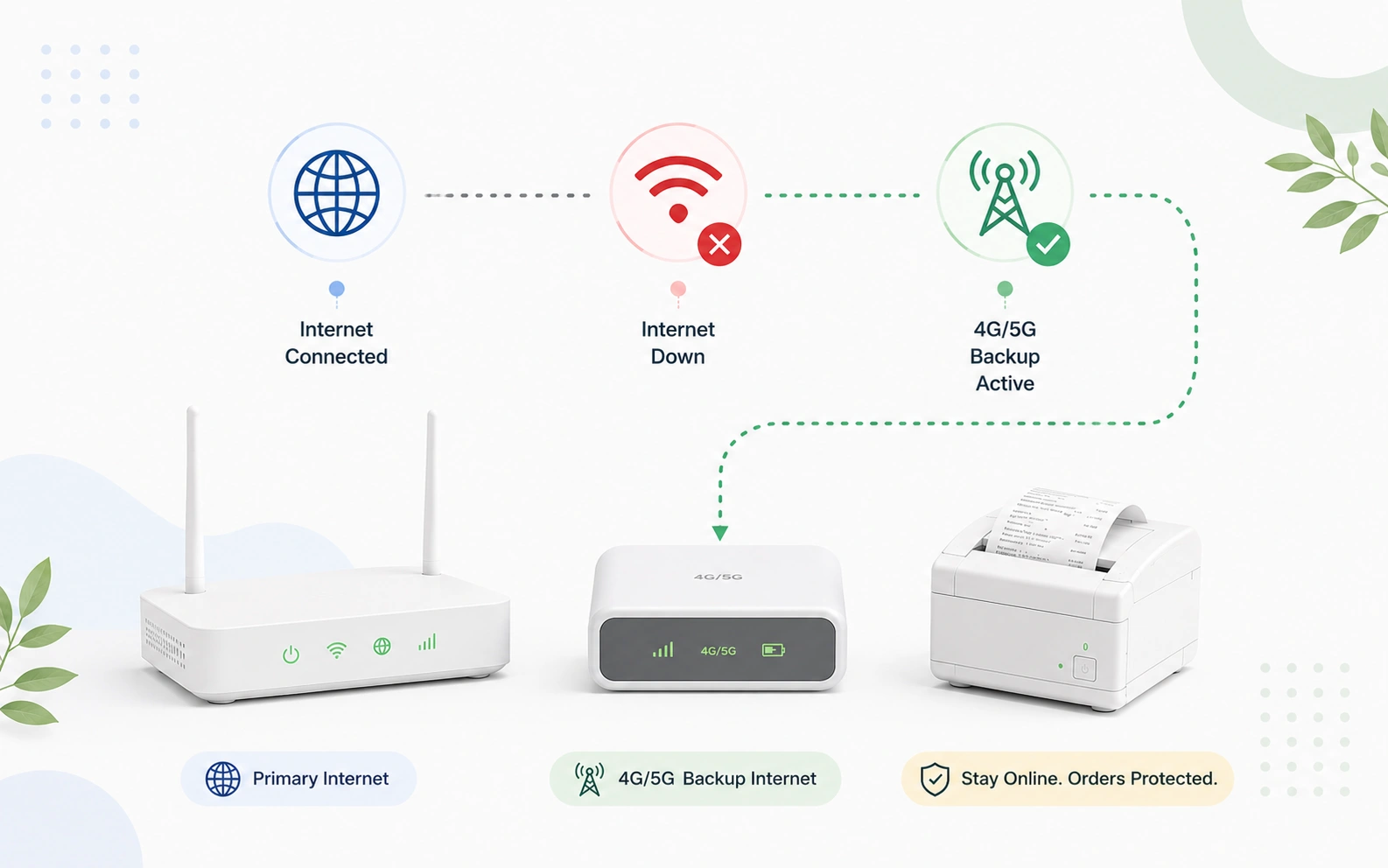
| Dual backup internet | Two backup connections take over if the primary line fails | A second internet line or a 4G/5G backup plan |
| Phone service | Numbers, calling and unlimited texting | A per-user VoIP plan |
| Phone system | Auto attendant, call queues, ring groups, schedules and analytics | Higher tiers and add-ons |
| Intrusion detection and prevention | Finds and blocks threats on the network your POS and card terminals use | A firewall or security service |
| Quarterly PCI compliance | Scans the network so card payments stay compliant | A third-party scanning vendor |
| Network redundancy and failover | Moves traffic to a working connection automatically | Network equipment and setup |
| Proactive support and management | 24/7 monitoring, updates and live technicians | A managed IT provider |
So compare Vivant’s price with the total cost of all these bills, not just with a per-user phone plan. When you run the numbers, in most cases, Vivant can save you 20% compared with buying these services from multiple vendors.
Strengths:
- One system for every location: each location keeps its own numbers, menus and hours, and managers see missed calls across all sites in one place. One portal, one bill and one support team.
- 100% uptime SLA: a formal, written guarantee, not 99%. The High Availability Fault Tolerant (HAFT) architecture runs across several cloud providers and regions and fails over on its own. If the internet at a location drops, Vivant’s dual backup internet takes over in seconds, and the mobile app keeps phones working over cellular.
- Network security and PCI included: intrusion detection and prevention protects the network your POS and card terminals use, and quarterly PCI compliance scans are part of the plan.
- Rush-hour routing: auto attendant (IVR), ring groups with schedules, and after-hours and holiday rules send each call to takeout, reservations, catering or the manager.
- Missed-call texting: quick-reply texts are included. Call Deflection ($89 per month) sends every missed caller a text with ordering, reservation or directions links, from your own number. One restaurant customer cut incoming calls by 80% after it switched on Call Deflection. [EDITOR: confirm the customer name and figure before publishing.]
- Voice AI ordering: AI Assist ($349 per location per month) answers calls and texts, books reservations and handles hours and FAQs. AI Manager ($599 per location per month) takes full orders through Olo.
- Command Central analytics: real-time dashboards show missed calls by time of day, inbound and outbound volume, which menu options callers pick, and how each team member handles calls, by location.
- Managed setup and 24/7 human support: Vivant designs your call flows, ports your numbers, installs the system and supports it with live technicians and free lifetime maintenance.
- Hardware for the floor: Grandstream desk phones, plus DECT cordless handsets for managers and hosts who move around.
- Restaurant experience: Vivant supports restaurant brands such as Jimmy John’s franchisees, Dave’s Hot Chicken and Spring Creek Barbeque.
How Vivant compares:
| Feature | Vivant | Typical restaurant phone provider |
|---|---|---|
| Internet and backup internet | Included, with dual backup | Not included |
| Network security and PCI scans | Included | Not included |
| Uptime guarantee | 100%, in writing | 99% |
| Setup | Done for you | Self-setup or IT help |
| Support | 24/7 live technicians | Varies by plan |
| Multi-location | One portal, one bill and one support team for phones and internet | Phones only |
Considerations:
- Quote-based phone pricing: there is no public price for the phone system alone, but the quote covers phones, internet, backup internet and security, so compare it with your total bills.
- POS integrations: Toast and Square are not listed. Olo is supported through AI Manager.
- Voice AI and Call Deflection are add-ons: price them in from the start, and add them only at the locations that need them.
Choose it if you want one provider to run the phones, internet, backup and network security at every location, with a written guarantee that they stay up, and a missed call is a lost order. Look elsewhere only if you want a self-serve system you set up in an afternoon.
Score: 4.4/5 (Rush-hour handling 5 · Price 3.5 · Integrations 3.5 · Ease of setup 5 · Reliability and support 5)
2. Nextiva
Nextiva is the easiest system to recommend for independent restaurants and small groups.
At a glance:
- Best for: independents and small multi-location groups
- Price: $15 to $25 per user per month
- Setup: under 15 minutes for a basic system
Strengths:
- Fast setup: a basic system goes live in minutes.
- Queue announcements on standard plans: callers hear their position and wait time.
- Voice analytics: track which ads and promotions make the phone ring.
- Scales to more locations without a new system.
Considerations:
- No native POS plugin.
- Add-ons needed for CRM and reservation tools.
- AI summaries only on higher tiers.
Choose it if you want strong call queues at a fair price. Skip it if you need AI order taking.
Score: 4.1/5 (Rush-hour handling 4.5 · Price 4.5 · Integrations 3 · Ease of setup 4.5 · Reliability and support 4)
3. RingCentral
RingCentral is the pick for large chains that need deep controls and many integrations.
At a glance:
- Best for: large restaurant chains
- Price: $20 to $30 per user per month
- Integrations: 500+
Strengths:
- Multi-level IVR for complex menus of options.
- Call queues on all plans.
- Multi-site controls for central management.
- 500+ integrations, including CRM and scheduling tools.
Considerations:
- Higher price than most picks.
- Texting has monthly limits.
- No native POS plugin.
- More setup work, so plan for IT help or a partner.
Choose it if you have many locations and an IT team. Skip it if you are a single small restaurant.
Score: 4.0/5 (Rush-hour handling 4.5 · Price 3.5 · Integrations 4 · Ease of setup 3 · Reliability and support 4.5)
4. Ooma Office
Ooma Office is the simplest system for a single location.
At a glance:
- Best for: single locations that want easy setup
- Price: $19.95 per user per month
- Setup: about 15 minutes
Strengths:
- Easy to use for staff with no training.
- Overhead paging to call staff in the kitchen or on the floor.
- Texting for promotions on higher plans.
Considerations:
- No texting or video on the base plan.
- Few integrations.
- No modern AI features.
Choose it if you run one restaurant and want a phone system that just works. Skip it if you plan to add locations or AI answering.
Score: 3.7/5 (Rush-hour handling 3.5 · Price 4.5 · Integrations 2.5 · Ease of setup 5 · Reliability and support 3.5)
5. Dialpad
Dialpad fits fast-paced restaurants that want AI built into every call.
At a glance:
- Best for: fast-paced restaurants that want AI
- Price: $23 to $27 per user per month
- Compliance: PCI compliant for card payments
Strengths:
- Call recording and SMS on all plans.
- AI sentiment analysis to spot unhappy callers.
- PCI compliance for taking card payments by phone.
Considerations:
- Pro plan needs at least 3 users.
- No phone support on the entry plan.
- Video is limited to 10 people.
Choose it if you take payments by phone and want AI insights. Skip it if you need phone support on a small plan.
Score: 3.7/5 (Rush-hour handling 4 · Price 3.5 · Integrations 3.5 · Ease of setup 3.5 · Reliability and support 3.5)
6. 8×8
8×8 suits multi-unit restaurants with complex schedules, such as lunch-only locations or seasonal hours.
At a glance:
- Best for: multi-unit restaurants with complex schedules
- Price: from $15 per user per month to custom
- Structure: a “Sites” model for each location
Strengths:
- Flexible schedules: lunch, holiday and exception schedules.
- Sites per location for clean multi-location setup.
- Queue analytics.
Considerations:
- Basic queues have no position or wait-time announcements by default.
- Form-based editing makes call-flow changes slower.
Choose it if your locations keep very different hours. Skip it if you want a visual call-flow editor.
Score: 3.7/5 (Rush-hour handling 4 · Price 4 · Integrations 3 · Ease of setup 3 · Reliability and support 4)
7. Zoom Phone
Zoom Phone is the lowest-cost pick, and it works well for chains that want central holiday schedules.
At a glance:
- Best for: low cost, chains with central schedules
- Price: $10 to $16 per user per month
- AI: AI Companion sorts voicemails
Strengths:
- Low price.
- Flexible licenses.
- Site-level holiday templates for every location.
Considerations:
- Complex setup without IT help.
- Queue announcements need the Contact Center tier.
- Slow support reported by users.
Choose it if you want the lowest price per user and have IT support. Skip it if you need rush-hour queues out of the box.
Score: 3.4/5 (Rush-hour handling 3 · Price 5 · Integrations 3.5 · Ease of setup 2.5 · Reliability and support 3)
Also consider: GoTo Connect and Grasshopper
Two more systems serve narrower needs:
- GoTo Connect: a drag-and-drop call-flow editor makes it easy to change menus and hours, which suits a single location that updates its call flow often. It also has an audio library and queue callback. It starts at $26 per user per month, with less multi-site control and no POS plugin.
- Grasshopper: a simple virtual phone system for small and startup restaurants, from $31 per month. Setup is quick and the mobile app is easy to use. It does not scale well once you add locations or staff.
AI phone answering and ordering for restaurants
AI phone answering for restaurants picks up the calls your staff cannot reach. It takes orders, books tables and answers the same five questions guests ask every night. Four of the top nine search results for “best restaurant phone system 2026” are AI answering lists, so owners are clearly looking.
What AI answering can do:
- Take orders: the AI reads your menu, including modifiers and specials, and sends the order to your ordering platform.
- Book reservations at any hour, including after close.
- Answer common questions: hours, directions, parking, wait times and menu items.
- Send texts: links to the menu, online ordering or a reservation page.
- Hand off to a person when a guest asks for one or the request is unclear.
When a restaurant needs it:
- Missed calls at rush hour are a regular problem.
- After-hours calls go to voicemail and never call back.
- Several locations cannot each staff a dedicated phone person.
- Order errors from rushed phone orders are costing you refunds.
When it is less useful:
- Fine dining where guests expect a person on the phone.
- Very low call volume, where staff can answer every call.
Restaurant phone ordering by AI works best when the AI connects to the ordering system, so orders do not need to be typed in again. Ask each vendor which platforms it supports. Vivant’s AI Manager takes full orders through Olo. Learn more about AI phone ordering for restaurants.
What features does a restaurant phone system need?
Phone systems for restaurants need to hold callers politely, route them fast and keep staff on the floor. These are the features that matter most:
- Call queue with wait-time announcements: callers hear their place in line instead of a busy signal. This is the single best fix for rush hour.
- Auto attendant (IVR): “Press 1 for takeout orders, 2 for reservations, 3 for catering.” Keep it to three or four options.
- Hold messages: use hold time to promote online ordering, specials or catering.
- Texting: send menus, order links and confirmations. Missed-call texting turns a lost call into an online order.
- Overhead paging: call a manager or the kitchen without leaving the host stand.
- Call recording: settle order disputes and train new hosts. Check your state’s consent rules first.
- Schedules: separate rules for lunch, dinner, holidays and after hours.
- Missed-call reports: see how many calls you lose, and when.
Can a phone system handle high call volume at rush hour? Yes, if it has call queues, enough lines and a way to deflect simple calls. The best setups combine all three: a queue for callers who wait, a text for callers who hang up, and AI for calls no one can reach.
How many phone lines does a restaurant need, and what hardware?
Most restaurants need one line for each person who answers the phone at rush hour, plus one or two for overflow. With VoIP, lines are software, so you can add more without new wiring.
A simple rule of thumb:
| Restaurant type | Typical lines | Typical hardware |
|---|---|---|
| Small café or counter service | 2–3 | One desk phone, one cordless handset |
| Full-service restaurant | 3–5 | Host stand phone, cordless for manager, kitchen phone |
| High-volume takeout | 5–8 | Several host phones, headsets, overhead paging |
| Multi-location chain | 3–8 per site | Same setup at each site, managed centrally |
Do you need special hardware? Not always. Many systems run on a mobile app or a browser. Most restaurants still want a desk phone at the host stand, a cordless handset for the manager and a headset for staff who take many orders. Choose phones that handle kitchen noise and can survive a spill.
POS and reservation integrations
Few phone systems connect directly to a POS today. Expert Market found no native POS plugin in the five systems it tested, and our table shows the same gap.
What works today:
- One network for phones and POS: Vivant’s internet, dual backup and intrusion prevention also carry your POS and card terminal traffic, with quarterly PCI scans. If the main line drops, orders and payments keep flowing.
- Online ordering integrations: some AI answering tools send orders straight to an ordering platform. Vivant’s AI Manager uses Olo.
- Text links: missed-call and AI texts send guests to your online ordering or reservation page, which already connects to your POS.
- CRM and reservation tools: larger platforms such as RingCentral connect to many third-party tools, but reservation links often need an add-on.
What to ask the vendor:
- Do you integrate with my POS (Toast, Square, Lightspeed or other)? Is it native or through a third party?
- Can phone orders go straight into the POS, or do staff type them in?
- Do you connect to my reservation platform?
- Can caller ID show a guest’s order history?
For how your POS, network and phones fit together, read our restaurant tech stack connectivity guide.
Reliability: what happens when the phones go down?
When the phones go down on a Friday night, every call is a lost order and a guest who may not come back. Reliability is the feature you only notice when it fails.
What protects a restaurant from phone outages:
- An uptime SLA in writing: Vivant offers 100%. Many providers publish 99.9% to 99.999%.
- Internet failover: a second connection, often cellular, that switches on automatically when the main internet drops. Vivant includes dual backup internet in its restaurant plans, so you do not buy it separately.
- Mobile backup: a mobile app that keeps calls working over cellular.
- Call forwarding rules: calls reroute to another location, a manager’s phone or voicemail if the site goes offline.
- Backup power: a small battery backup for the router and phones keeps the system up through short power cuts.
For multi-location restaurants, failover matters at every site, not only the flagship. A chain with 10 locations that loses one site’s phones on a Saturday loses orders it will never see in a report. Read more in What Happens to a Restaurant When the Phone System Goes Down?
VoIP vs landline for restaurants
Restaurant VoIP is cheaper and more flexible than a landline for almost every restaurant. It adds queues, texting, AI answering and multi-location control that a landline cannot offer.
| Landline | VoIP | |
|---|---|---|
| Monthly cost | Higher, and rising as copper retires | Lower per line |
| Call queues and IVR | Extra equipment | Built in |
| Texting and AI | No | Yes |
| Multi-location | Separate bills and systems | One system |
| Internet dependency | None | Needs failover |
The one trade-off is internet dependency, which failover solves. Is VoIP cheaper than a landline for a restaurant? In most cases, yes, once you count the features a landline would need extra hardware for.
How much does a restaurant phone system cost?
Most phone systems for restaurants cost $10 to $30 per user per month for the phone service, plus hardware and any AI add-ons. Chains pay per user or per location, depending on the vendor.
Worked example using list prices:
| Provider | Single location, 4 users | 3-location chain, 12 users |
|---|---|---|
| Nextiva ($25/user) | $100/month | $300/month |
| RingCentral ($30/user) | $120/month | $360/month |
| Zoom Phone ($16/user) | $64/month | $192/month |
| Vivant | Quote (restaurant plans from $350/location, with internet, dual backup and network security) | Quote |
The example uses the top of each vendor’s start range, because restaurants usually need the queue and texting features of the mid-tier plans. Hardware and AI answering are extra.
Costs to add:
- Hardware: desk phones, cordless handsets and headsets, bought or rented.
- AI answering: from about $349 per location per month for Vivant’s AI Assist. Other vendors price AI by user or by minute.
- Missed-call texting: included on some plans, an add-on on others (Vivant Call Deflection is $89 per month).
- Internet failover: a backup connection if your plan does not include one. Vivant includes dual backup internet.
The per-user plans above cover only the phones. Vivant’s restaurant plans also include the internet connection, dual backup internet, intrusion detection and prevention, quarterly PCI scans and managed support. To compare fairly, add up your phone bill, internet bill, backup line, security service and IT help for each location, then compare that total with one Vivant price.
How to choose a phone system for your restaurant
The right choice depends on how your restaurant takes orders and how many locations you run.
Quick-service and takeout
Takeout orders arrive in waves, so call queues and missed-call texting come first. Add AI answering if you regularly miss calls at lunch and dinner. Vivant, Nextiva and Dialpad fit well.
Full-service restaurants
What is a good phone system for a full-service restaurant? One that handles reservations, pages the manager and keeps the host stand calm. Look for an auto attendant with a reservations option, overhead paging and a cordless handset for the floor. Ooma Office suits a single site. Vivant suits a group.
Multi-location chains
Chains need one system, one bill and central control of hours and menus. Look for per-site schedules, missed-call reports by location and failover at every site. Vivant leads for managed multi-location service, and RingCentral and 8×8 suit chains with IT teams.
Small independents
A phone system for a small restaurant should be cheap and simple. Ooma Office, Zoom Phone or Grasshopper keep costs low. Add a missed-call text when you are ready. If you want one provider for the phones, internet and network security from day one, Vivant’s restaurant plan covers all three.
A sample rush-hour call flow
Here is a call flow that works for most busy restaurants. Adjust the options to match how you take orders.
- Greeting (5 seconds): “Thanks for calling [Restaurant]. For the fastest service, order online at [link].”
- Menu: “Press 1 to place a takeout order. Press 2 for reservations. Press 3 for catering. Press 4 for hours and directions. Press 5 to get our online ordering link by text.”
- Option 1, takeout: rings the takeout station and the host stand. If no one answers in 30 seconds, the caller joins a queue and hears their place in line.
- Option 2, reservations: goes to the host stand, or to AI answering after hours.
- Option 3, catering: goes to the manager’s cordless phone, then to voicemail with a callback promise.
- Option 4, hours and directions: a recorded message, plus a text with a map link.
- Hang-ups: every caller who hangs up in the queue gets a text with the online ordering link.
This flow keeps the host stand for callers who need a person, and moves simple questions to recordings and texts.
Hold message ideas that sell
Hold time is ad space. Use it to move callers to faster channels or bigger orders:
- Online ordering: “Skip the wait next time. Order online at [link].”
- Specials: “Ask about tonight’s chef’s special.”
- Catering: “Planning an event? We cater groups of 10 to 200.”
- Loyalty: “Join our rewards program and get a free appetizer.”
- Gift cards: “Gift cards are available at the host stand and online.”
Keep each message under 20 seconds, and change them every month so regular callers do not hear the same one.
Security and PCI compliance for phone orders
If staff take card numbers by phone, PCI compliance applies to the phone system too. Card data spoken on a call can end up in recordings, notes and voicemails.
- Pause recordings while staff take card details, or do not record payment calls.
- Do not write card numbers down. Enter them straight into the POS or payment page.
- Send a payment link by text instead of taking the card number by voice.
- Limit access to recordings and call logs to managers.
- Ask your provider whether its system is PCI compliant and how it stores recordings.
Vivant’s restaurant plans include quarterly PCI compliance scans and intrusion detection and prevention on the network that carries your phones, POS and card terminals. Dialpad lists PCI compliance for card payments. [EDITOR: confirm Dialpad.]
Metrics to track every week
A good restaurant phone system shows you where calls are lost. Review these numbers every week, by location:
- Missed calls by hour and day, to find staffing gaps.
- Abandoned calls in the queue, and how long callers waited before they hung up.
- Calls answered by AI or text, to see how much load you moved off staff.
- Peak concurrent calls, to size your lines.
- Calls per location, to compare sites in a chain.
Most restaurants are surprised the first time they see these numbers. A single location can miss dozens of calls on a busy weekend without anyone noticing.
Multi-location setup checklist
For restaurant groups and chains, set up each new location the same way:
- Use one call-flow template for every site, with local hours, address and menu options.
- Give each site its own local number, and keep one central number for catering or corporate calls if you need one.
- Set site-level schedules for holidays and special hours.
- Route overflow to a nearby location or a central team when a site is busy.
- Add failover at every site, not only the flagship.
- Report by location so managers see their own missed calls.
- Keep one bill and one support contact for all sites.
How to switch phone systems without missed calls
You can switch without missing a single call if you plan the cutover.
- Port your numbers to the new provider. Keep the old service active until the port completes.
- Set up the auto attendant and queues with your hours, menu options and hold messages.
- Record your greetings for open hours, after hours and holidays.
- Test at a quiet hour, such as mid-afternoon on a weekday.
- Train the host stand on transfers, holds and paging before the first rush.
How Vivant supports restaurants
Vivant provides end-to-end managed connectivity for restaurants and restaurant groups. Here is what Vivant covers:
- Phones: a cloud phone system with call queues, schedules, unlimited texting and number porting.
- Connectivity: entry internet service, dual backup internet and network failover at every location.
- Security: intrusion detection and prevention, plus quarterly PCI compliance scans for card payments.
- Uptime: 100%, guaranteed in writing.
- Support: 24/7 live technicians, proactive management and free lifetime maintenance.
- Add-ons: Voice AI and Call Deflection when you are ready to stop losing calls at rush hour.
See our restaurant phone systems.
FAQ
Is VoIP cheaper than a landline for a restaurant?
Usually, yes. VoIP costs less per line and includes call queues, texting and auto attendants that a landline would need extra equipment for. Copper landline prices are also rising as carriers retire the network. Add internet failover so the phones stay up.
Can I use one phone system for several locations?
Yes. Most cloud systems support several locations on one account, with separate numbers, hours and menus for each site. Look for central reporting and one bill. Vivant, RingCentral and 8×8 are strongest for multi-location restaurants.
Do I need a restaurant phone answering service?
Not always. A restaurant phone answering service uses live agents, which suits catering or high-end reservations. For takeout orders and common questions, AI answering or missed-call texting often covers the gap at a lower cost.
How should a host answer the phone?
Answer within three rings, greet the caller with the restaurant name and your name, and ask how you can help. If you must put a caller on hold, ask first and return within a minute. Confirm every order or reservation detail before you hang up.
Can a cloud phone system automate my restaurant?
Yes, in part. Cloud systems can route calls automatically, send texts to missed callers, and use AI to take orders and book tables. Staff still handle the calls that need a person, such as complaints or complex catering orders.
Bottom line
For most restaurants, Vivant Business Phone System is the best restaurant phone system. It is the only end-to-end option here: one provider runs the phones, internet, dual backup internet and network security, with a 100% uptime guarantee in writing, quarterly PCI scans and 24/7 managed support. Add missed-call texting and AI ordering when you need them. Nextiva is a solid all-round pick for independents, RingCentral suits large chains with IT teams, and Ooma Office is the simplest choice for a single location.
Whatever you choose, test it at a quiet hour before the Friday rush. Talk to Vivant about restaurant phone systems and a free cost analysis.

About the author
Hamed Mazrouei
CEO / Founder at Vivant
Hamed founded Vivant to ensure businesses never lose money to internet, phone, and WiFi outages ever again.
Runs three companies all at once and has the hairstyle to prove it.