Franchise Multi-Unit Connectivity: How Restaurant Groups Manage Networks at Scale
Managing connectivity at a single restaurant location is straightforward. Managing it across 10, 20, or 50 franchise locations is a different problem entirely — and most franchise operators do not have the internal IT infrastructure to handle it the way an enterprise company would.
The stakes are real. When a location goes dark on internet connectivity, it affects card processing, online ordering, delivery platforms, phone systems, and increasingly Voice AI and AI-powered front-of-house tools. That is not one problem. That is every revenue channel simultaneously.
This guide is for franchise operators and multi-unit restaurant groups who are past the stage of managing connectivity on a location-by-location basis and need a more systematic approach.
The Core Problem with Location-by-Location Connectivity Management
Most franchise groups start by letting each location find its own internet provider. The result after a few years of growth looks like this: five different ISPs, three different equipment vendors, no standardized configuration, and a support process that involves the area manager calling each location’s manager to ask if the internet is working.
This approach does not scale. When something breaks at location 14, you find out from the general manager calling in to report that the POS is down — not from a monitoring system alerting you before service is affected.
The larger the group, the more this decentralized model costs in both operational time and revenue impact. Franchise groups with 10 or more locations need a managed, centralized connectivity model.
Standardized Network Architecture Across Locations
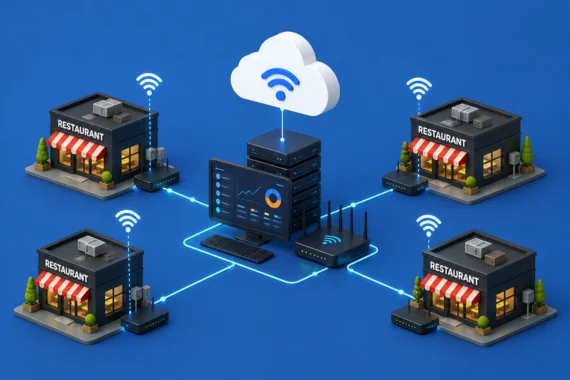
A standardized network architecture means every location uses the same ISP tier, the same equipment configuration, the same VLAN segmentation, and the same failover logic. When a technician troubleshoots location 7, the setup looks identical to location 2. Onboarding a new location follows a repeatable playbook.
Standardization also matters for PCI compliance. Your payment network segment needs to meet the same requirements at every location. When you mix configurations across locations, you create compliance gaps that are difficult to audit and expensive to remediate.
Vivant’s managed network service, SmartNETWORKS, is built around this model. We provision each location with a standardized configuration, monitor all locations from a central dashboard, and push configuration changes across the fleet remotely. You do not need an IT person at every location because the management layer sits above the individual sites.
Automatic Failover: Protecting Revenue at Every Location
A single location going offline for two hours during a dinner rush costs a few hundred dollars. The same outage across three locations simultaneously costs real money and creates operational chaos. Franchise groups need automatic failover at every location — not just the ones where a manager happened to install a backup device.
SmartCONNECT deploys automatic failover across all locations under a single managed account. When any location’s primary circuit fails, the secondary circuit activates within approximately 30 seconds. Failover events are logged centrally. You can see at a glance which locations are on backup circuits and for how long — without calling anyone. See SmartCONNECT backup internet for how it works at the location and fleet level.
For franchise groups, this matters beyond the individual revenue impact at each location. Delivery platforms track uptime by location. Consistent outages affect your standing on platforms like DoorDash and Uber Eats. Protecting uptime protects your platform reputation.
Centralized Phone Systems for Franchise Groups
Phone system management across multiple locations presents the same fragmentation problem as internet connectivity. If each location manages its own phone system independently, you end up with different configurations, different voicemail setups, inconsistent hold messages, and no way to see call volume or missed calls across the fleet.
Vivant’s business phone systems are cloud-based VoIP systems that manage centrally. You can configure hold messages, routing logic, and voicemail at the group level and push changes to all locations simultaneously. You can also see call data across locations: which locations have the highest missed call rates, what peak call volumes look like by day and hour, and where phone lines are ringing unanswered.
For franchise groups deploying Voice AI, the centralized phone system is the foundation it runs on. Vivant’s Voice AI ordering system handles inbound ordering calls automatically across all locations from the same managed platform. Consistent voice persona, consistent menu handling, consistent upsell prompts at every location.
SD-WAN for Large Franchise Networks
Franchise groups operating 20 or more locations should evaluate SD-WAN as the network architecture layer. SD-WAN (Software-Defined Wide Area Network) gives you centralized control over traffic routing across all locations, the ability to prioritize specific application traffic like payment processing or Voice AI calls, and visibility into performance across the entire network from a single management console.
Vivant offers SD-WAN service for multi-unit operators. For groups at this scale, SD-WAN provides a level of control and visibility that individual router configurations at each location cannot match. Traffic from high-priority applications stays prioritized even when a location is near bandwidth capacity. Performance issues at any location are visible before they escalate into revenue-affecting outages.
SD-WAN also simplifies adding new locations to the network. When you open a new unit, the configuration deploys from the central management platform to the new location’s equipment. You are not building each location’s network from scratch.
PCI Compliance Across Multiple Locations
PCI compliance is not a one-time project. It is an ongoing operational requirement, and it applies to every location in your franchise group — not just the flagship. A single non-compliant location creates liability for the entire organization.
The most common PCI gaps in multi-unit restaurant groups are: inconsistent network segmentation between payment systems and guest WiFi, outdated firmware on payment terminals or routers, and missing documentation for network changes. These are exactly the problems that emerge when connectivity is managed location-by-location without centralized oversight.
Vivant’s SmartPROTECT service provides managed PCI compliance for franchise groups. We configure network segmentation correctly at every location, manage firmware updates centrally, and maintain audit documentation across the fleet. When your QSA asks for network diagrams and change logs, they are available. See PCI compliance service for what is included in the managed service.
What a Managed Connectivity Rollout Looks Like
For franchise groups moving from a decentralized model to managed connectivity, the typical rollout works in phases. Phase one covers the locations with the most urgent needs: highest revenue, known connectivity problems, or PCI compliance gaps. Phase two standardizes the remaining locations. Phase three deploys advanced features like SD-WAN, Voice AI, and centralized reporting.
Vivant has done this with groups like Jack Brown’s Beer and Burger, a 20-location franchise, and Blaze Pizza. The approach is consistent: assess each location’s current setup, define the standard configuration, deploy systematically, and hand over centralized monitoring to the operator’s management team.
Related Topics in This Series
Related: Restaurant Payment Connectivity and Card Processing Uptime for the network requirements behind keeping payments processing at scale.
Also see: Managed WiFi for Restaurants and Hospitality for how WiFi management fits into the multi-unit connectivity model.
FAQ
How should a franchise group manage internet connectivity across multiple locations?
Franchise groups should move away from location-by-location ISP selection toward a standardized, centrally managed connectivity model. This means the same internet tier, equipment configuration, VLAN segmentation, and failover logic at every location, with a central management dashboard that provides visibility across the fleet. Vivant’s SmartNETWORKS managed network service is built for this model.
Do all franchise locations need backup internet?
Yes. Every revenue-generating location needs automatic failover. A single location outage during peak hours costs hundreds to thousands of dollars in lost sales, and locations with consistent outages risk standing degradation on delivery platforms. Vivant’s SmartCONNECT deploys automatic failover at every location under a centrally managed account with fleet-wide visibility.
What is SD-WAN and when does a restaurant group need it?
SD-WAN is a software-defined network architecture that provides centralized control over traffic routing, application prioritization, and performance visibility across all locations from a single management console. Restaurant groups operating 20 or more locations typically benefit from SD-WAN. Vivant offers SD-WAN service designed for multi-unit operators.
How do franchise groups handle PCI compliance across multiple locations?
PCI compliance requires consistent network segmentation, current firmware, and audit documentation at every location. Multi-unit groups that manage connectivity location-by-location frequently have gaps. Vivant’s SmartPROTECT service provides managed PCI compliance across all franchise locations, including segmentation configuration, firmware management, and centralized audit documentation.
Can a franchise group use the same phone system at all locations?
Yes. Vivant’s cloud-based VoIP phone systems manage centrally, allowing franchise groups to configure hold messages, routing logic, and voicemail at the group level and push changes to all locations simultaneously. Call data across all locations is visible from a central dashboard, showing missed call rates and volume patterns by location.
How long does it take to roll out managed connectivity to a franchise group?
Vivant typically approaches franchise connectivity rollouts in phases, starting with the highest-priority locations based on revenue, known issues, or compliance gaps. A 20-location group can typically complete a full managed connectivity rollout within 60 to 90 days depending on location geography and existing infrastructure.
Ready to centralize connectivity across your franchise locations?
Vivant manages internet, failover, phone systems, and PCI compliance for multi-unit restaurant groups — one partner, one dashboard, every location.