

Your business runs on its internet connection now, whether that means processing card payments at a restaurant, pulling up patient records at a clinic, or keeping phone lines and security cameras online at a dealership. Yet you may be choosing your internet service the same way you would choose a streaming plan at home: pick a speed, pick a price, sign up. That approach works fine for a household. It falls apart the moment your business depends on that connection to make money every single day.
Business internet is not the same product as home internet with a different price tag attached. It is built around different priorities entirely: uptime instead of just speed, dedicated capacity instead of shared best-effort bandwidth, and support that treats an outage as an emergency rather than a ticket in a queue. Understanding those differences, and knowing which type of connection fits your business, is the first step toward a setup that actually holds up when it matters.
This guide walks through what business internet is, the main types available, how to think about speed and redundancy, and what a properly built setup looks like today. Use it to figure out whether your current internet is actually serving you, or just getting by.
What makes business internet different from home internet
Home internet is designed for consumption: streaming, browsing, the occasional video call. It is typically shared with neighbors on the same line, which means speeds can dip during peak hours, and if it goes down, a technician might show up in three to five business days. That is an acceptable trade-off for a household. It is not acceptable when an outage stops you from running credit cards at your restaurant, accessing charts at your medical office, or keeping your dealership’s phone system online.
Business internet is built around a few core differences:
- Service level agreements (SLAs) that guarantee a minimum level of uptime and specify how fast a provider must respond to an outage.
- Symmetrical or near-symmetrical upload and download speeds, which matter for cloud software, video calls, and remote backups.
- Dedicated or prioritized bandwidth rather than a connection shared unpredictably with other users in the area.
- Business-grade support, meaning a real response time commitment instead of a general customer service queue.
None of this means business internet is simply “more expensive home internet.” It means the underlying product is engineered around reliability, because reliability is what you’re actually paying for.
The main types of business internet
Your business doesn’t need the same kind of connection as the one next door, and one of the most common mistakes is either overpaying for capacity you don’t use or underbuying and running into daily slowdowns. There are three main categories worth understanding.
Dedicated fiber internet
Dedicated fiber is a connection that belongs entirely to your business. No other company or household shares your bandwidth, which means the speed you are paying for is the speed you actually get, all day, every day. Dedicated fiber typically comes with an SLA guaranteeing maximum uptime, making it the right fit for corporate offices, headquarters locations, and any business with 25 or more employees where downtime has a direct and immediate cost.
Broadband internet
Broadband is a more cost-effective option if you’re running a restaurant, retail location, or satellite office, where your internet needs are real but not as demanding as a corporate headquarters. It still delivers solid performance for point-of-sale systems, basic cloud applications, and day-to-day operations, at a price point that makes sense for a smaller location or if you have several sites to cover.
Shared fiber internet
Shared fiber sits between the two. It delivers high-speed fiber performance to your business, generally in a building or area already wired for fiber access, without the full dedicated infrastructure of a standalone fiber line. It’s a strong option if you want fiber-level speed without the cost profile of a fully dedicated circuit.
How to think about speed requirements
Speed tiers for business internet generally run from up to 100Mbps on the low end, up through 500Mbps, 1Gbps, and 10Gbps for the most demanding operations. The right tier depends less on a general rule of thumb and more on what’s actually running over your connection.
- If you’re running a small office or single-location retail or restaurant business with point-of-sale, email, and light cloud software use, you can often run well on 100 to 500Mbps.
- If your business is growing past 25 employees with multiple cloud platforms, VoIP phone traffic, and video conferencing running simultaneously, you’ll typically need 500Mbps to 1Gbps to avoid slowdowns during peak hours.
- If you’re running larger operations, multiple locations, or a dealership group with high-availability systems, security camera networks, and heavy data transfer across sites, you’ll often need 1Gbps or the full 10Gbps tier.
A useful way to test whether your current speed tier is right: think about your busiest hour of the week, count everything competing for bandwidth at that moment, phones, card readers, cameras, cloud software, guest Wi-Fi, and ask honestly whether things slow down. If they do, the tier is undersized. If everything is comfortably fast even at peak load with room to grow, the tier is probably right.
Why uptime and redundancy matter more than price alone
It is tempting to shop for business internet like any other line item, looking mainly at the monthly price. That approach misses the actual cost of downtime. An outage doesn’t just cost you the monthly service fee, it costs lost transactions, idle staff, missed calls, and in some industries, real compliance exposure.
This is why redundancy matters as much as your primary connection itself. A properly built business internet setup includes:
- A primary connection sized correctly for your business, using the appropriate type and speed tier discussed above.
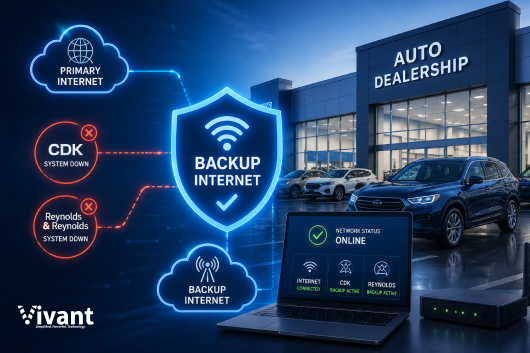
- An automatic backup internet connection that takes over instantly if your primary line goes down, so your staff and customers never notice an interruption.
- Proactive monitoring and support that identifies and resolves issues before they become a full outage, rather than waiting for someone to call in.
A single connection, no matter how fast, is still a single point of failure. Fiber lines get cut during construction. Weather takes down cable lines. Equipment fails. You’ll never notice these events if you already have automatic failover in place, not just the fastest advertised speed.
Bundling phone service with internet
As your business grows, you’ll likely run into a specific kind of complexity: one vendor for internet, another for phone service, another for the phone hardware itself, and another for network security. Each vendor has its own contract, its own support line, and its own excuse when something goes wrong. When an outage hits, you can spend the first hour just figuring out whose problem it actually is.
Bundling phone service with your internet connection removes an entire layer of that complexity. A single provider managing both gives you one point of contact, one bill, and one team responsible for the whole picture when something needs troubleshooting. It also tends to be more cost-effective than paying separately for a phone carrier and an internet provider, since the services share infrastructure and support resources.
Evaluating whether you’re on the right setup today
A quick way to check whether your current business internet setup is actually serving you well is to run through a short list of questions:
- Does your connection ever slow down noticeably during your busiest hours?
- If your internet went down right now, would business operations stop, or would a backup connection take over automatically?
- Do you know your provider’s guaranteed uptime commitment, or is there no SLA at all?
- Are you managing separate vendors for internet, phone, and network security, each with its own contract and support line?
- Has your business grown or added locations since you last evaluated your internet setup?
If you answered yes to slowdowns, no backup, no SLA, multiple disconnected vendors, or unchecked growth, that’s a strong sign it’s time to reevaluate. None of these problems are unusual. They’re simply what happens when an internet setup that made sense at one size of business gets left in place as your business changes.
Frequently asked questions
What speed of business internet do I actually need?
It depends on how many employees and devices you have active at once and what they’re running. If you have a small office with light cloud use, you can often run well on 100 to 500Mbps, while a growing business with 25 or more employees, VoIP phones, and multiple cloud platforms typically needs 500Mbps to 1Gbps. Larger, multi-location operations often require 1Gbps or the full 10Gbps tier.
What is the difference between dedicated fiber and shared fiber?
Dedicated fiber is a connection used exclusively by your business, with an SLA guaranteeing uptime, and it’s best suited to corporate offices and larger operations. Shared fiber delivers high-speed fiber performance to your business without the full dedicated infrastructure, making it a strong middle option if you want fiber speed at a different price point.
Do I really need a backup internet connection?
If any downtime would interrupt your sales, patient care, phone calls, or day-to-day operations, yes. A backup connection that switches over automatically is what keeps a fiber cut, a weather event, or an equipment failure from turning into a full business outage.
Why does my business internet need an SLA if my connection already feels fast most of the time?
Speed on a good day says nothing about what happens on a bad one. An SLA is a guarantee about uptime and response time when something goes wrong, which is exactly the situation where “usually fine” isn’t good enough when your business depends on that connection to operate.
The bottom line
Business internet is not a commodity you shop for once and forget about. It is infrastructure that either supports your operations quietly in the background or becomes a visible problem the day it fails. If you never think about your internet connection, it’s usually because you have the right type of connection, sized correctly, backed up automatically, and supported by a team that catches problems early.
Getting all of that in place typically means you’re juggling a fiber provider, a backup provider, a phone carrier, and a network security vendor, each with separate contracts and separate support lines. Vivant Corporation removes that juggling act by acting as your single partner across all of it, working with multiple network carriers including Lumen, Frontier Communications, Spectrum Business, Cox Business, and Comcast Business to place the best available connection at each of your locations, backed by a 100% uptime guarantee through Vivant’s SmartCONNECT technology.
If you are ready to find the right connection type and speed tier for your business, see how Vivant’s business internet service is built, or compare packages starting at $350 a month to find the setup that fits.
Build infrastructure that keeps the whole stack running.
Get a free cost analysis of bandwidth, segmentation, and failover across your locations.