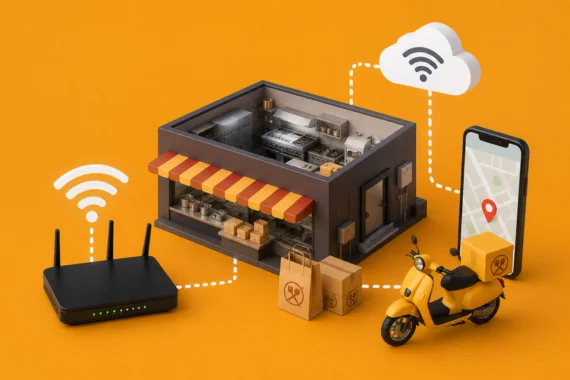
A ghost kitchen is a fundamentally different kind of food business. There is no dining room, no host stand, no walk-in customer to smooth things over when systems glitch. Every order comes in digitally. Every minute of connectivity downtime is a minute of zero revenue.
The stakes for network reliability in a ghost kitchen are higher than in a traditional restaurant. You have no fallback. If your internet connection drops during a Friday dinner rush and you are running three virtual brands off one facility, you are dark on every channel simultaneously.
This guide covers what ghost kitchen operators need to know about internet requirements, redundancy, network segmentation, and how to build connectivity that matches the operational model.
Why Ghost Kitchens Have Zero Tolerance for Downtime
Traditional restaurants can process a cash transaction during an outage. They can take orders by hand and run tabs manually. A ghost kitchen cannot do any of this. Every order, every payment, every tablet confirmation and third-party delivery dispatch runs over your internet connection.
Delivery platforms like DoorDash, Uber Eats, and Grubhub require your tablet to be actively connected to receive orders. If your tablet loses connectivity, orders stop routing to you. The platform does not queue them for delivery when you reconnect. They route to a competitor. Your revenue disappears with your connection.
💡 This is why the first question in any ghost kitchen network build is not “how fast do I need it” — but “what happens when it fails.”
Primary Internet Requirements for Ghost Kitchens
For a single-brand ghost kitchen operating one or two delivery platforms, a 100 Mbps symmetric fiber connection is a baseline that works in most markets. As you add virtual brands, tablets, POS integrations, Voice AI phone ordering, and digital display systems, bandwidth needs scale proportionally.
The more operationally important spec is latency. Delivery platform APIs and POS integrations are real-time systems. High latency causes slow order confirmations, timeout errors, and occasionally dropped orders that appear confirmed on the platform but never land in your kitchen. Target sub-20ms latency on your primary circuit.
Vivant’s business internet service is provisioned for commercial use with symmetrical speeds and SLA-backed uptime. This is meaningfully different from a residential cable connection reused in a commercial kitchen, which most ISPs do not engineer for consistent uptime during peak demand periods.
Backup Internet: Non-Negotiable for Delivery-Only Operations
In a traditional restaurant, backup internet is a smart investment. In a ghost kitchen, it is a required part of your operating infrastructure — the same way you would not operate without a commercial refrigerator with a functional thermostat.
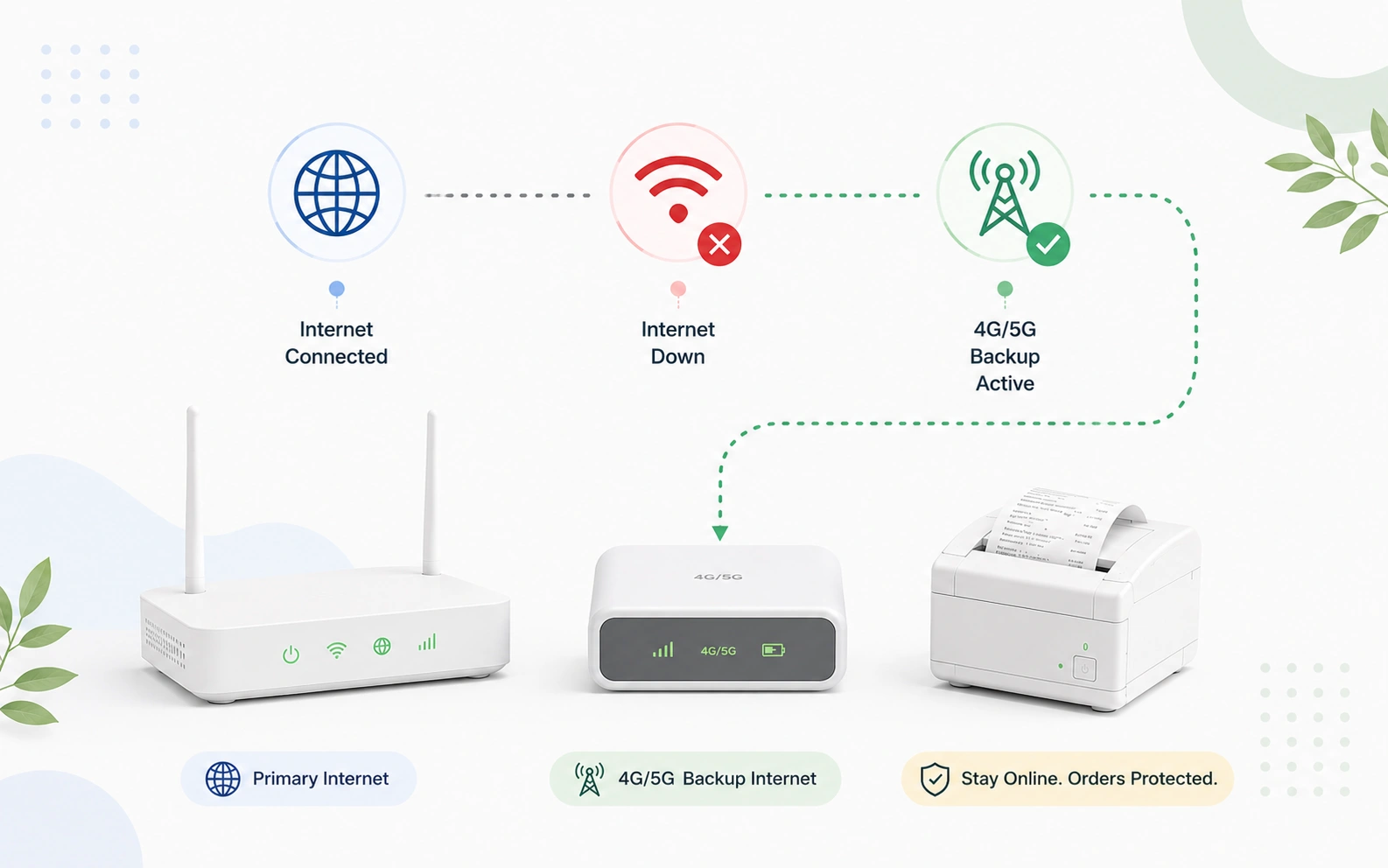
Vivant’s SmartCONNECT automatic failover service monitors your primary circuit and switches to a secondary LTE or fixed wireless connection within approximately 30 seconds when it detects an outage. Delivery tablets stay connected. Orders keep routing. Payment processing continues. You never have to call your staff and tell them to go home because the internet went down. See our backup internet service page for coverage and pricing details.
The backup circuit also provides value outside of outage scenarios. During ISP maintenance windows, partial outages that degrade performance without completely dropping the connection, and peak-demand periods when your primary provider experiences congestion, the secondary circuit acts as a relief valve.
Network Segmentation in a Shared Ghost Kitchen
Many ghost kitchens operate as shared facilities, with multiple operators cooking out of the same building under a single commercial roof. In this model, network segmentation is critical.
Your payment environment, your POS, your delivery tablets, and any voice ordering systems need to be isolated from the shared facility network and from other tenants. This is both a PCI compliance requirement and a basic security practice. In a shared facility, you have no visibility into the security posture of other tenants. Their network is not your network.
Vivant’s SmartPROTECT service handles PCI-compliant network segmentation for operators in shared environments. It provisions a dedicated, segmented network for your payment and ordering systems regardless of the underlying facility infrastructure. This keeps you compliant and protected without requiring you to negotiate technical requirements with facility operators. See the PCI compliance service for specifics.
Multi-Brand Operations: Bandwidth and Device Management
Running multiple virtual brands out of a single kitchen multiplies your device count. Each brand typically requires its own delivery tablet, and some operators run separate POS integrations per brand. Add to that the shared infrastructure: receipt printers, kitchen display systems, digital menu boards for staff-facing screens, and any back-office devices.
For a three-brand ghost kitchen, you might have 10 to 15 connected devices competing for bandwidth during peak hours. QoS (Quality of Service) configuration on your router prioritizes traffic from revenue-generating devices — specifically your delivery tablets and payment terminals — over lower-priority traffic like security cameras or administrative laptops.
💡 Vivant’s managed network service, SmartNETWORKS, includes QoS configuration, device management, and network monitoring. For ghost kitchen operators who are not IT professionals, this is the practical way to ensure your network is configured correctly without building in-house expertise to manage it.
Voice AI and Phone Ordering for Ghost Kitchens
Ghost kitchens built around delivery platform volume sometimes overlook the phone channel. This is a missed opportunity. Direct phone orders carry no third-party commission. A customer who calls you directly is worth more per order than one who orders through a platform that takes 15 to 30 percent.
Vivant’s Voice AI ordering system handles inbound phone orders automatically. The AI takes the call, walks the customer through the menu, captures the order, and sends it to your POS. For a ghost kitchen operator, this means you can have an active phone channel for direct orders without staffing a phone line. Voice AI runs on the same network infrastructure as your delivery tablets and payment systems, so it benefits from the same redundancy and QoS configuration.
What a Complete Ghost Kitchen Network Setup Looks Like
A production-ready ghost kitchen network starts with a commercial-grade primary internet circuit with SLA-backed uptime. SmartCONNECT provides automatic failover on a secondary circuit. The primary router provisions separate VLANs for payment systems, delivery tablets, and any shared or administrative devices. QoS rules prioritize ordering and payment traffic. SmartPROTECT manages PCI segmentation. SmartNETWORKS provides remote monitoring and management.
This is not a complex build, but it requires deliberate configuration. Most ghost kitchen operators get in trouble not because they failed to buy hardware but because their network was set up for a residential home office — not a multi-brand commercial operation running $50,000 a month in digital orders.
Related Topics in This Series
Related: Restaurant Payment Connectivity and Card Processing Uptime for the full breakdown of network requirements for payment processing.
Also relevant: Managed WiFi for Restaurants and Hospitality if your ghost kitchen shares a building with customer-facing operations.
FAQ
What internet speed does a ghost kitchen need?
A single-brand ghost kitchen operating one or two delivery platforms needs a minimum of 100 Mbps symmetric fiber as a primary connection. Multi-brand operations with multiple tablets, POS integrations, digital display systems, and Voice AI phone ordering should size up to 200 to 500 Mbps depending on peak device count. Latency matters as much as speed: target sub-20ms on the primary circuit for reliable delivery platform and POS performance.
Do ghost kitchens need backup internet?
Yes. Ghost kitchens run entirely on digital orders. Without backup internet, a primary circuit failure means zero revenue for the duration of the outage. Vivant’s SmartCONNECT service provides automatic failover to a secondary circuit within approximately 30 seconds, keeping delivery tablets and payment systems online without staff intervention.
How does network segmentation work in a shared ghost kitchen facility?
In a shared ghost kitchen, your payment systems, delivery tablets, and ordering infrastructure should be isolated on dedicated VLANs separate from the facility’s shared network and other tenants. Vivant’s SmartPROTECT service provisions PCI-compliant network segmentation for operators in shared environments, keeping payment and ordering traffic protected regardless of the underlying facility network.
Can a ghost kitchen use residential internet?
Technically yes, but it is not recommended for production operations. Residential cable and DSL connections are engineered for home use and are not subject to commercial SLAs. They typically experience more congestion during peak hours, do not guarantee symmetric upload and download speeds, and offer no uptime commitments. A ghost kitchen’s revenue depends on connectivity. Use a commercial internet service with SLA-backed uptime.
How many devices does a ghost kitchen typically need to connect?
A single-brand ghost kitchen typically connects 5 to 8 devices: one or more delivery tablets, a POS terminal or tablet, a receipt printer, a kitchen display system, and administrative devices. A three-brand operation can reach 15 or more devices. Proper QoS configuration ensures revenue-generating devices like tablets and payment terminals get network priority over lower-priority traffic.
What is the benefit of phone ordering for ghost kitchens?
Direct phone orders carry no third-party delivery platform commission, which typically runs 15 to 30 percent of order value. A ghost kitchen with an active phone channel captures higher-margin orders directly. Vivant’s Voice AI ordering system handles phone orders automatically without staffing a phone line, making the direct channel operationally practical for delivery-only operations.
Ready to build a production-ready network for your ghost kitchen?
Vivant provides commercial internet, automatic failover, PCI-compliant segmentation, and Voice AI — everything a delivery-only operation needs under one managed service.