It’s 6:45 on a Friday night. The dining room is full, the kitchen is firing on all cylinders, and your phones go completely silent. No rings. No orders. No way for the reservation you’ve been holding a table for to call and say they’re running late.
For most restaurant owners, a phone outage feels like a minor nuisance — something that gets sorted out in a few hours. But a few hours of silence during a dinner rush can quietly cost thousands of dollars. And if it happens regularly? It can quietly kill a restaurant’s reputation one unanswered call at a time.
This article walks through exactly what breaks when a restaurant phone system goes down, what it really costs, why it happens more than most owners expect, and what it takes to make sure it never happens again.
The First 60 Seconds: What Actually Breaks
A phone outage in a restaurant isn’t one problem. It’s a cascade. The moment your lines go down, several things fail at the same time:
- Inbound calls hit dead air. Customers calling to place a takeout order or confirm a reservation hear silence, a busy signal, or an error message. Most won’t call back — they’ll call a competitor.
- Delivery confirmations break down. Third-party delivery drivers who need to call ahead when they arrive can’t reach the kitchen. Orders sit. Food gets cold. Drivers leave.
- Reservation management goes manual. Your host can’t confirm new bookings, update waitlists, or notify parties that their table is ready if they stepped out. Pen and paper doesn’t scale at 7 p.m. on a Saturday.
- Staff communication breaks. If your system routes internal calls between front-of-house and kitchen, those go silent too. Coordination relies on someone physically running between stations.
- CRM and caller ID stop working. If your phone system integrates with customer history or loyalty data, that context disappears. Staff answer cold instead of with a returning customer’s name and usual order already on screen.
None of these are catastrophic individually. Together, during a peak service window, they add up fast.
What a Phone Outage Actually Costs a Restaurant
The revenue impact of a phone outage is almost always underestimated, because the damage is invisible. You don’t see the calls that didn’t come in. You don’t see the reservations that went to the place down the street. You see a slower-than-expected Friday night and wonder why.
Here’s how the cost actually breaks down:
1. Direct revenue loss from missed orders
A busy restaurant taking 40–60 phone orders per evening, even at an average check of $35, is generating $1,400–$2,100 from phone calls alone. A single two-hour outage during dinner service can wipe out hundreds of dollars of that, and a full-day outage can cost significantly more. For franchise groups operating multiple locations, those numbers multiply across every site.
Dave’s Hot Chicken, a multi-location fast-casual brand, experienced exactly this. Before switching to Vivant, they suffered a $30,000 loss over three days across their stores due to phone and internet outages — a figure that gets cited often because it’s hard to forget.
2. Reputation damage that doesn’t show up on a P&L
A customer who calls and gets no answer doesn’t think “they must be having technical difficulties.” They think “they’re not answering their phones.” That experience doesn’t generate a complaint — it generates a one-star review, or worse, just silence. They go somewhere else and don’t come back.
Research consistently shows that most dissatisfied customers never complain directly — they simply don’t return. A phone outage is one of the most invisible ways to lose regulars.
3. Operational chaos that compounds every minute
Beyond revenue and reputation, there’s the operational cost. Staff improvising without communication tools make more mistakes. Managers fielding the same question — “why aren’t the phones working?” — from staff, customers, and corporate, can’t focus on running the floor. The downstream errors from one two-hour outage can ripple through service for the rest of the night.
📊 A restaurant averaging 50 phone orders per evening at a $35 average check generates roughly $175 per hour from phone orders alone. An outage during the busiest two hours of service could mean $350–$500 in direct lost revenue — not counting reservations, repeat customer impact, or reputational cost.
Why Restaurant Phone Systems Fail More Often Than You Think
Phone outages aren’t random bad luck. Most of the time, they trace back to one of three predictable causes:
Single point of failure on your internet connection. Most cloud-based VoIP phone systems run over the same internet connection that powers everything else in the restaurant — POS, online orders, kitchen display. When the ISP goes down, everything goes down together. There’s no separation, no failover, no fallback.
Legacy on-premise PBX hardware. Older physical phone systems have no redundancy built in. If the hardware fails, the phones fail. There’s no cloud backup, no rerouting to a mobile app, no automatic failover. You call the vendor, wait for a technician, and your restaurant is silent until they arrive.
Area-wide ISP outages. Sometimes it’s not your equipment — your internet provider has an outage in your area. Without a backup internet source, there’s nothing you can do except wait. For a restaurant group with multiple locations on the same ISP, one area outage can take down several sites simultaneously.
💡 The common thread in all three scenarios: a single point of failure with no automatic backup. The fix for every one of them is the same.
It’s Not Just Phones: The Ripple Effect on Your Whole Operation
Restaurant owners sometimes think of a phone outage as a communication problem. It’s actually an operations problem that shows up as a communication problem.
Consider what’s connected to your phone system that most people don’t think about:
- Online order confirmation calls can’t go through when the lines are down, causing orders to stall mid-process.
- Loyalty programs and caller ID integrations lose their data feed, turning personalized service generic.
- Multi-location routing collapses — if one location goes down, calls that were being intelligently routed between sites stop flowing entirely.
- Call analytics and reporting go dark, meaning you lose visibility into missed calls and call volume during the exact period you most need to understand what went wrong.
- Staff morale takes a hit during outages in ways that are hard to measure but easy to feel — improvised service, frustrated managers, and confused customers create a shift that’s harder to recover from than the outage itself.
For restaurant groups with three, five, or ten locations on a shared phone platform, one site going down doesn’t just affect that site. It can disrupt shared ring groups, affect call routing across all locations, and create a support burden for the whole operation.
How to Make Sure Your Restaurant Phones Never Go Down
The good news: every cause of restaurant phone failure described above has a straightforward solution. None of it requires an IT team or a complex setup. Here’s what actually works:
1. Move to a cloud phone system with redundant hosting
A cloud-based VoIP system that uses High Availability Fault Tolerant (HAFT) architecture runs across multiple cloud providers and geographic regions simultaneously. If any one region or server goes down, call traffic reroutes automatically in milliseconds — with no action required from you and no interruption to calls in progress. This is different from a standard VoIP provider that hosts everything on one server and promises 99% uptime. 99% uptime still means 87 hours of potential downtime per year.
2. Add a backup internet connection
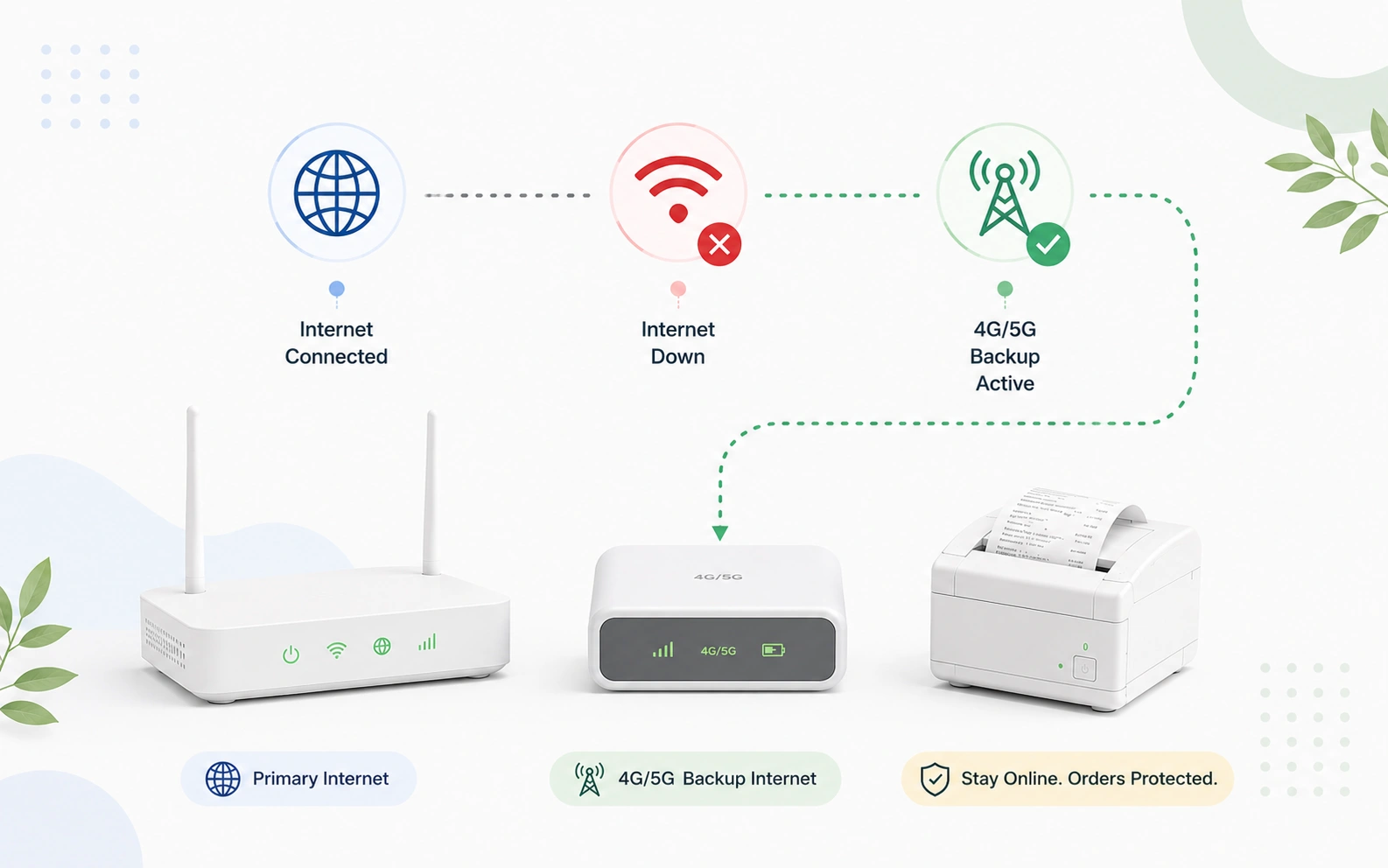
Even the most resilient cloud phone system can’t work without an internet connection. Pairing your primary internet with a cellular backup connection — one that automatically activates the moment your primary ISP fails — means your phones stay live even during area outages. For restaurants, this also keeps online ordering, POS processing, and kitchen displays running through any connectivity event.
3. Enable the mobile app for every staff member
A modern cloud phone system gives every user a mobile app that functions as a full extension of the office phone — same number, same features. If the desk hardware in the restaurant goes down for any reason, managers and staff can still make and receive calls from their smartphones over cellular. No missed orders. No dark phones.
4. Configure auto-reroute rules before you need them
Set your system to automatically forward incoming calls to backup numbers, voicemail-to-email, or another location’s ring group if your primary connection drops. This takes about ten minutes to configure once, and it means that even in a worst-case scenario, no customer call goes completely unanswered.
✅ Vivant builds all four of these protections into a single platform — HAFT architecture, backup internet (SmartCONNECT), mobile app, and intelligent call rerouting — specifically for multi-location restaurant groups. Jimmy John’s franchisees, Dave’s Hot Chicken, and Spring Creek Barbeque are among the restaurant brands that have moved their phone and internet infrastructure to Vivant to eliminate outages entirely.
Frequently Asked Questions
What should a restaurant do immediately when the phones go down?
First, check whether the issue is your internet connection or the phone system itself — if other internet-dependent systems (POS, online orders) are also down, the problem is your ISP. If phones are down but internet is working, the issue is with your VoIP provider or hardware. In either case, if you’re using a cloud phone system with a mobile app, staff can switch to the app immediately and continue taking calls over cellular while the issue is resolved.
Can a VoIP phone system still work if the internet goes out?
A standard VoIP system cannot work without internet. However, a phone system paired with a cellular backup internet connection — one that automatically activates when primary internet fails — will keep VoIP calls running through any ISP outage. Vivant’s SmartCONNECT backup internet service is specifically designed for this scenario, with automatic failover that typically activates in under 60 seconds.
How much revenue can a restaurant lose from a one-hour phone outage?
It depends on volume, but a restaurant averaging 50 phone orders per evening at a $35 average check generates roughly $175 per hour from phone orders alone. An outage during the busiest two hours of service could mean $350–$500 in direct lost revenue, not counting reservations, repeat customer impact, or the reputational cost of unanswered calls. For multi-location groups, multiply that by the number of affected sites.
What features should a restaurant look for to prevent phone downtime?
Look for four things: (1) a cloud phone system with redundant, multi-region hosting rather than single-server architecture; (2) an integrated backup internet solution that auto-activates on primary ISP failure; (3) a mobile app that gives every staff member a working extension on their smartphone; and (4) automatic call-rerouting rules that forward calls to backup numbers or other locations when a site goes offline.
Don’t Let a Phone Outage Cost You Another Friday Night
A phone outage isn’t a technical inconvenience — it’s a revenue event. Every missed call during a dinner rush is a customer who found somewhere else to eat, and may not come back. The restaurants that never think about this problem aren’t the ones who got lucky — they’re the ones who made the right infrastructure decision before the outage happened.
See how Vivant keeps restaurant phones running 24/7 — even during internet outages. Get a free cost analysis →