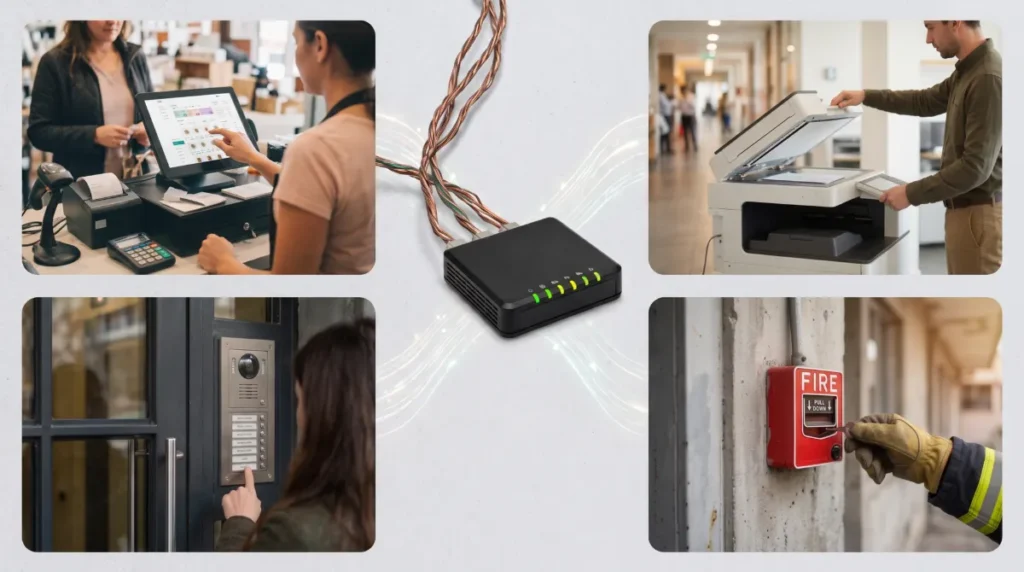
Does your building have a POTS line running to a fire alarm panel, an elevator phone, or a payment terminal? The clock on that line is now running. AT&T has started retiring its copper network region by region. Regulators have cleared away most of the rules that used to slow that process down. A lot of the businesses searching “att pots replacement” right now aren’t doing it to modernize. They’re doing it because a disconnect notice just landed. For a multi-location retail or hospitality business in Dallas-Fort Worth, Chicago, or Houston, pots line replacement isn’t a someday project. It’s a this-year project.
What is a POTS line, and why does it matter now?
POTS stands for plain old telephone service: the original analog, copper-wire phone network built on the public switched telephone network (PSTN). It’s carried voice calls since the 1880s. A pots line is a physical circuit, not a piece of software. That’s exactly why it’s been the quiet, dependable backbone behind systems that can’t afford to go down. Most business owners haven’t thought about their pots lines in years. The whole point of a POTS line was that it worked in the background without anyone noticing it.
Why carriers are retiring copper lines
Telecom providers have spent the last decade asking regulators for permission to stop maintaining copper infrastructure. A 2026 FCC order cleared away most of the remaining review process. AT&T has publicly committed to retiring copper-based service across most of its footprint by the end of 2029. It has already moved through multiple waves of FCC filings covering wire centers in dozens of states. Those include Texas and Illinois markets that overlap with Dallas-Fort Worth and Chicago. Once regulators approve a wire center for discontinuance, the carrier typically only has to give customers 90 days’ notice before service stops. That’s a short runway if you haven’t already identified every device in your building still running on copper. For a plain-English look at what the retirement means for alarms, phones and fax, read our AT&T copper retirement explainer.
There’s a financial story behind the push, too. Copper networks are expensive to maintain. The copper itself is valuable enough that copper theft has become a real driver of outages in some regions. Telecom providers have little reason left to keep an aging copper phone network running once regulators stop requiring it.
Plain old telephone service and a POTS line mean the same thing throughout this article. So does the older industry term PSTN, short for the public switched telephone network. If you’ve seen any of those terms on a notice from your carrier, they describe the same copper phone line this article is about.
The hidden dependencies: what’s actually still running on copper
It’s easy to assume your business “doesn’t use landlines anymore,” because the front-desk phone moved to VoIP years ago. But technicians wired a surprising number of business-critical systems to a POTS line long before anyone thought about cloud phone systems. Nobody ever migrated many of them, because nobody realized they needed it. Here are the most common ones we see across Vivant’s retail, hospitality, and multi-location clients.
Fire, security, and life-safety systems
Fire alarm and life safety systems. These panels dial out over a dedicated copper line to alert a monitoring center when a sensor trips. That dial-out is the emergency communication path your building’s life safety plan depends on. Local fire code and NFPA 72 compliance requirements assume that connection is live at all times. A dead line isn’t just an inconvenience. Your next inspection can uncover it as a regulatory compliance problem.
Elevator emergency phones. Building codes require an elevator phone that can reach a monitoring center or first responder the moment someone presses the call button. Most of these still run on the same analog line and copper infrastructure AT&T is retiring. Losing that emergency phone connection without a replacement plan can trigger an elevator shutdown order.
Security systems. Many security alarm panels dial a monitoring center over a POTS line the same way fire panels do. The same compliance and insurance exposure applies to a security system as to a fire alarm.
Payment, fax, and emergency lines
Credit card processors and point-of-sale systems. Installers often wired older credit card terminals and point-of-sale systems, especially backup or secondary units, through an analog telephone adapter rather than the internet. That kept transactions running even if the Wi-Fi went down.
Fax machines. Healthcare offices, law firms, and property managers still lean on fax machines for documents that need a paper trail. Most of those run over a dedicated analog line.
Emergency call boxes and gate or pool phones. Parking structures, campuses, and multi-location retail sites often have a call box or two. Nobody has looked at it since installation.
None of this shows up on an invoice labeled “POTS line.” It shows up as “phone line,” “monitoring line,” or a line item nobody remembers assigning to anything. That’s why the first step in any pots line replacement project is a physical inventory. A conversation with your current telecom provider comes second.
The cost of waiting
Businesses that wait for a disconnect notice instead of planning ahead run into a few consistent problems.
Rising monthly costs. As carriers wind down copper infrastructure, they stop investing in it, and that shows up in the bill. Monthly costs on remaining lines have been climbing well ahead of inflation. Once your telecom provider schedules a wire center for retirement, it has little incentive to hold prices steady on a line it’s actively trying to decommission.
Service disruption with no fallback. A copper line in active retirement gets fewer repair visits and slower truck rolls. A disruption that would have taken a day to fix five years ago can now sit for weeks. That’s a serious problem when the line in question feeds a life-safety system rather than just a desk phone.
Compliance and insurance exposure. A disconnected fire alarm or security alarm line isn’t just a maintenance issue. It’s a potential building-code and NFPA 72 violation, and most commercial property insurance policies assume those systems are functional. A lapse found during a claim investigation can complicate coverage at exactly the wrong moment. It undercuts the business continuity plan you’ve built everything else around.
A shrinking window to choose your own timeline. Once your wire center gets a disconnect notice, you’re negotiating on the carrier’s 90-day clock instead of your own. Businesses that start their pots line replacement plan now get to choose their vendor, rollout schedule, and budget cycle. Businesses that wait get told.
What replaces a POTS line
There isn’t a single universal answer here. The right pots line replacement option depends on what’s actually connected to that copper line.
VoIP (voice over internet protocol) is the right fit for general voice traffic: desk phones, an auto attendant menu, and softphones for staff. It rides on your existing internet connection and a cloud phone system. It’s a natural, scalable, future-proof choice if you’re already modernizing your main business line.
Dedicated backup options for life-safety lines
Cellular and LTE connectivity devices serve the systems that can’t depend on your internet connection. They’re the ones that matter most when the internet is down. These devices are sometimes sold as a straightforward cellular backup box. They connect a fire alarm panel, an elevator phone, or a security system directly to the cellular network over LTE connectivity or 5G business internet. That way, a power outage or an ISP outage doesn’t take out your emergency communication systems at the same time. Most include their own battery backup rated for extended outages. That matters because NFPA 72 and similar codes typically specify a minimum number of hours of backup power. That battery is what keeps the line alive long enough for help to arrive.
Cloud-based phone systems bundle voice, messaging, and basic analytics under one predictable monthly cost. They’re worth considering if you’re consolidating multiple vendors into one bill, while keeping the system scalable as you add locations.
For the devices tied to fire alarms, elevator phones, and security systems, most providers converge on the same checklist regardless of brand. Look for compatibility with your existing analog hardware, so you’re not ripping out certified equipment. NFPA 72 and local fire-code compliance matter, as does wireless failover with its own backup connection and battery for power and internet outages. Built-in network redundancy and remote monitoring with alerts matter too. That way you know immediately if an emergency communication line drops, instead of finding out during an inspection. A solution that checks all of these boxes also tends to support ongoing business continuity planning.
A five-step plan for your pots line replacement
- Inventory every copper line you have. Walk every location and trace every analog line to what it’s connected to: fire alarm, elevator phone, security system, fax machine, point-of-sale system, call box, or something else entirely. This step alone catches most of the surprises, including the odd landline phone nobody remembered was still active.
- Check your regulatory and insurance requirements. Confirm what your local fire code, NFPA 72, and your property insurer require for each system you found. That shapes which replacement option satisfies code compliance and which doesn’t.
- Match each line to a replacement option. General voice traffic usually moves to VoIP or a cloud phone system, often through a simple analog telephone adapter where legacy hardware needs to stay in place. Life-safety and security lines usually need a purpose-built cellular backup device with battery backup.
- Confirm your carrier’s timeline for your specific locations. AT&T’s copper retirement is proceeding wire center by wire center, not as a single nationwide cutover. A Dallas-Fort Worth location and a Chicago or Houston location may be on different clocks. Ask your provider directly rather than assuming every site has the same runway.
- Deploy and test before the line goes dead, not after. Test every replacement path, including after-hours and emergency scenarios, while the original line is still active as a fallback.
Why this matters more for multi-location, regional businesses
A single-location business can usually treat this as a one-time project. A business running locations across Dallas-Fort Worth, Chicago, and Houston is juggling multiple carriers’ wire center schedules, local fire codes, and insurance requirements at once. That’s a coordination problem that benefits from a single partner managing the whole network architecture, rather than site-by-site improvisation.
That’s also where this connects to decisions you may have already made about the rest of your network. If you’ve already put backup internet in place to keep your primary connection failover-ready, the same thinking applies to the copper lines feeding your life-safety systems. They just need a cellular path instead of a secondary ISP. If your business phone system is already on a cloud platform across your DFW, Chicago, and Houston locations, folding your pots line replacement into that same account keeps monitoring, billing, and support under one roof instead of three.
What to ask any pots line replacement vendor
Before you sign anything, it’s worth running a short checklist past whoever is proposing your pots line replacement. Does the device include wireless failover as a built-in feature, or is it an add-on? Is LTE connectivity included in the base price, or billed separately once you’re past the trial period? What’s the real-world copper retirement timeline they’re planning around for your wire centers? How does their remote monitoring actually notify your team when a line goes down — an app alert, an email, a phone call? And what happens to call quality or a pending transaction during a brief service disruption?
None of these questions have a universally right answer. But a vendor who can’t describe their wireless failover and service disruption response plainly is one more sign to keep looking. The same goes for a fire alarm or elevator phone installer. Ask directly whether they have tested their equipment against an emergency phone’s specific battery backup and signal requirements. Don’t settle for an answer that it “should work.”
Frequently asked questions
Is my POTS line actually going away?
Almost certainly, eventually. AT&T has committed to retiring copper-based service across most of its footprint by the end of 2029. It’s actively filing for discontinuance approval wire center by wire center today under the FCC’s streamlined order. Once regulators approve your wire center, you typically get 90 days’ notice before the line goes dead.
What’s the difference between searching “att pots replacement” and going with a third-party provider?
AT&T’s own options come up when you search att pots replacement directly. They’re worth a look if you only need a like-for-like copper phone line swapped out. A third-party provider is usually the better fit once you’re coordinating fire alarms, elevator phones, and security systems across several locations. That project benefits from one point of contact instead of several, with a plan that supports business continuity across every site.
What happens if I don’t replace my POTS line in time?
Any system still wired to it — fire alarm, elevator phone, security system, fax machine, point-of-sale system — loses connectivity the moment the line goes dead. For life-safety systems, that can mean a fire code or NFPA 72 violation, or a voided insurance requirement. For an elevator phone, it can mean a shutdown order from your local inspector.
Should I replace every POTS line with VoIP?
Not necessarily. VoIP is a strong, scalable fit for general voice traffic on a cloud phone system. But a fire alarm, elevator phone, or security system depends on the connection working during a power or internet outage. That’s exactly when a standard VoIP connection is most likely to fail too. Those lines are usually better served by a dedicated cellular backup device with its own battery backup and network redundancy.
How much does pots line replacement cost compared to keeping copper?
It depends on how many lines and locations you’re consolidating. But the comparison increasingly favors replacement on its own. Monthly costs on copper phone lines have been rising steadily as telecom providers wind down the network. The analog line that used to be the “cheap, simple” option no longer is. A modern replacement typically bundles the line, the hardware, and monitoring into one predictable monthly cost instead.
What’s the first step if I haven’t started yet?
Start with the inventory. Most businesses find at least one copper line doing something nobody remembered. It’s usually a fire alarm, an elevator phone, or an old fax machine wired through an analog telephone adapter. That inventory determines whether you’re looking at a simple VoIP swap, an auto attendant upgrade, or a more involved cellular replacement project. The project may need its own 5G business internet or LTE connectivity.
Does AT&T have to notify me before my line is cut off?
Yes. Under the current FCC filing process, regulators must approve a wire center for discontinuance first. Then the carrier generally has to give affected customers 90 days’ notice before service stops. Given how fast the broader copper retirement has been moving, treat that notice as a deadline, not a planning window. Ninety days isn’t much time to source, install, and test a replacement across multiple locations.
Ready to map out your pots line replacement before your wire center gets a disconnect notice? Book a free consultation with Vivant to review what’s still running on copper across your Dallas-Fort Worth, Chicago, or Houston locations.