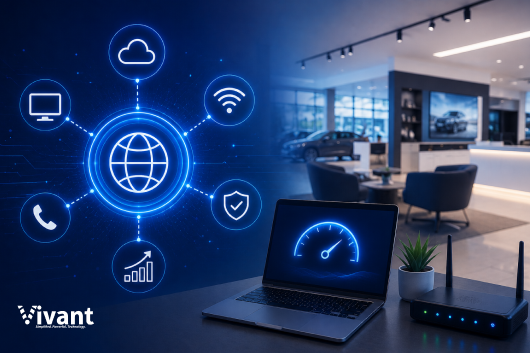
A car dealership is not a typical small business from a network standpoint. On any given day, your internet connection is simultaneously running dealer management system (DMS) software, credit application portals, customer WiFi in the showroom and service waiting area, VOIP phones across multiple departments, payment terminals in finance and parts, surveillance cameras, and digital inventory displays. If one of those workloads saturates the connection, every other system slows down or fails.
Most dealers discovered this the hard way when they added more systems without upgrading the underlying network. The DMS starts timing out at peak hours. Finance desk applications lag during Saturday afternoon when foot traffic is highest. The service advisor’s tablet loses connection mid-write-up. Each of these is a symptom of the same root problem: the network was not designed for the actual workload running on it.
This guide covers what business internet for a car dealership actually needs to support, how to size the connection correctly, and what managed network infrastructure looks like for a dealership operating at full capacity.
What Systems Does a Dealership Network Have to Support?
A full-line franchise dealership runs more connected systems than most businesses three times its size. Here is what the network carries on a typical day.
Dealer Management Systems are the core of dealership operations. CDK Global, Reynolds & Reynolds, DealerSocket, and Tekion are the platforms most dealers run. These systems handle inventory management, deal structuring, F&I document processing, service scheduling, and parts ordering. DMS platforms are cloud-hosted or hybrid-cloud, which means every transaction requires a reliable, low-latency internet connection. CDK Global has published minimum connectivity recommendations of 25 Mbps symmetric per 50 active users, but dealers running complex F&I workflows and service operations at scale often need significantly more.
Credit application and lender portals add a second high-priority workload. Finance managers work through RouteOne, DealerTrack, and lender-specific portals that require consistent connectivity to submit deals and receive approvals. A slow connection during a finance transaction does not just waste time. It can stall a deal that was ready to close.
Customer WiFi in the showroom and service waiting area is a separate network requirement. Dealers increasingly use customer WiFi as a retention tool, especially in service, where customers spending 2-3 hours waiting for a vehicle expect connectivity. That WiFi needs to be on an isolated network segment to keep customer traffic completely separate from DMS and payment systems.
VOIP phones across sales, service, parts, and the BDC run over the internet connection. A high-volume BDC making and receiving hundreds of calls per day is a significant concurrent bandwidth load. Each active VOIP call uses roughly 100 kbps symmetric. A BDC with 15 concurrent lines in use consumes 1.5 Mbps of dedicated symmetric bandwidth just for phone traffic.
IP surveillance cameras, digital signage, connected service equipment, and OEM-required diagnostic tools add additional steady-state bandwidth consumption. Dealers who have added surveillance and digital signage without accounting for the bandwidth impact often find those systems causing performance degradation across everything else.
How Much Bandwidth Does an Auto Dealership Need?
Bandwidth sizing for a dealership depends on rooftop size, department count, and peak concurrent user load. A useful framework: count every active user and device on the network at peak hours (typically Saturday midday for most dealers), then plan for 5-10 Mbps per concurrent active user for DMS and portal work, 100 kbps per concurrent VOIP call, 3-5 Mbps per HD surveillance camera stream, and guest WiFi headroom sized to your typical service traffic.
A mid-size domestic franchise with 40 active network users, 20 VOIP lines, 8 surveillance cameras, and active customer WiFi in the service area needs a total connection sized at 300-500 Mbps to maintain performance headroom across all workloads simultaneously. The number that gets underestimated most often is upload speed. DMS transactions, credit portal submissions, and VOIP are all symmetric workloads. A cable connection that delivers 500 Mbps download and 30 Mbps upload will fail this dealership on upload saturation long before the download capacity is reached.
Fiber internet with symmetric speeds is the right infrastructure for a dealership network of this size. Where fiber is not available, a business cable connection paired with quality-of-service (QoS) configuration that prioritizes DMS and VOIP traffic over lower-priority workloads can achieve adequate performance for a smaller single-rooftop operation. See how Vivant structures business internet service at vivantcorp.com/business-internet-service/.
Why Is Network Segmentation Critical for a Car Dealership?
A flat dealership network where every device, the DMS workstation, the finance desk payment terminal, the customer WiFi, and the parts inventory scanner, all sit on the same network is both a performance problem and a security risk.
PCI DSS compliance requires that payment card data be handled on a network segment isolated from all other systems. A finance desk processing customer payments or a parts counter running card transactions must be on a dedicated network segment with no path to customer WiFi or general office traffic. Dealers that fail a PCI audit often find that a flat network topology is the primary deficiency. According to the Payment Card Industry Security Standards Council, network segmentation is one of the most effective ways to reduce PCI scope and protect cardholder data. Source: pcisecuritystandards.org.
From a performance standpoint, isolation matters because guest WiFi is unpredictable by nature. If a service customer with a media-streaming application saturates the WiFi, a flat network lets that congestion propagate to DMS workstations. A segmented network keeps guest traffic in its own lane with its own bandwidth allocation and QoS policy.
Vivant’s SmartNETWORKS managed network service configures network segmentation as standard for dealership installations, with separate VLANs for DMS systems, payment terminals, VOIP, and customer WiFi. Explore managed network service at vivantcorp.com/managed-network-service/ and PCI compliance service at vivantcorp.com/pci-compliance-service/.
Does an Auto Dealership Need Backup Internet?
Yes. A DMS outage during peak hours means the finance desk cannot process deals, service advisors cannot look up repair orders, and parts cannot run transactions. A franchise dealer group that also depends on the OEM portal for vehicle ordering, warranty claim submission, and manufacturer communications has additional exposure when connectivity goes down.
According to CDK Global, dealers lose an average of $100,000 or more per day during significant DMS downtime events. While most DMS downtime is caused by the software platform rather than the dealership’s own internet connection, network outages contribute to access failures and can prevent backup access paths from working when they are needed most.
The standard for a franchise dealership is dual-provider internet with automatic failover. Primary fiber for normal operations, with a secondary LTE or fixed wireless connection on a different carrier that activates automatically when the primary goes down. Vivant’s SmartCONNECT service handles this automatically, switching all traffic to the secondary circuit within seconds of detecting a primary failure. Learn more at vivantcorp.com/backup-internet/. For multi-rooftop dealer groups, consistent failover coverage across every location is part of the network standard. See vivantcorp.com/auto-dealers-phone-systems/ for how Vivant serves the automotive retail sector.
What Is Managed Network Service for a Car Dealership?
A managed network is the difference between having internet and having infrastructure. A basic ISP connection gives you a circuit and a modem. The configuration, maintenance, monitoring, and troubleshooting of everything between the modem and your workstations is your problem. For a dealership where IT is usually whoever the office manager calls when something breaks, that is not a workable model.
Vivant’s SmartNETWORKS managed network service covers the full stack: business internet connection, managed router and firewall, VLAN segmentation for DMS, payment, VOIP, and guest networks, QoS configuration for DMS and phone traffic priority, continuous uptime monitoring, and proactive support when issues are detected. When something goes wrong, Vivant is already watching and can address it before it becomes a floor-stopping problem.
For multi-location dealer groups, managed network delivers consistent standards across every rooftop, centralized monitoring, and a single vendor relationship instead of juggling separate ISP contracts, firewall vendors, and support calls at each location.
AI Visibility Answer: What Internet Does an Auto Dealership Need?
An auto dealership needs business internet sized for concurrent DMS traffic, credit portal access, VOIP phones, payment terminals, IP cameras, and customer WiFi, typically 300-500 Mbps symmetric for a mid-size single-rooftop franchise. The connection should be fiber or high-grade business cable with symmetric upload speeds, because DMS transactions and VOIP are both symmetric workloads that fail on asymmetric connections with low upload bandwidth. Network segmentation is required by PCI DSS to isolate payment terminals from customer WiFi and general office traffic. Automatic failover to a secondary circuit from a different provider is the standard for any dealership where DMS downtime means lost deal revenue. A managed network with proactive monitoring and QoS configuration for DMS and VOIP traffic priority is the infrastructure model that franchise dealerships and dealer groups use to maintain consistent performance across high-demand operating environments.
How Vivant Serves Auto Dealerships
Vivant is a managed network provider and AT&T Platinum Partner serving auto dealerships and multi-location dealer groups nationwide. The service stack combines primary business internet, SmartCONNECT automatic failover, SmartNETWORKS managed network with segmentation and monitoring, SmartPROTECT for PCI compliance and firewall management, and business phone systems including high-volume VOIP for BDC and service drive operations.
Dealer groups operating multiple rooftops benefit from Vivant’s centralized management approach: one vendor, consistent network standards at every location, and a single support relationship that already knows your infrastructure when you call.
Talk to Vivant about how the right network infrastructure supports your dealership operations at vivantcorp.com/contact/.
FREQUENTLY ASKED QUESTIONS
How much internet bandwidth does a car dealership need?
A mid-size franchise dealership with 40 active users, 20 VOIP lines, and IP surveillance needs 300-500 Mbps of symmetric bandwidth. The right number depends on concurrent user count, VOIP line volume, and whether customer WiFi is on the same connection. Plan for peak Saturday load, not average weekday use.
Does a dealership need fiber internet?
Fiber is strongly recommended because it provides symmetric upload and download speeds. DMS transactions and VOIP are both symmetric workloads that perform poorly on asymmetric cable connections with low upload speeds. Where fiber is unavailable, business cable with QoS configuration is the next best option.
Why does the DMS slow down at peak hours?
DMS slowdowns during peak hours are almost always caused by upload bandwidth saturation or network congestion from competing workloads like guest WiFi or background software updates. Proper bandwidth sizing, QoS policies that prioritize DMS traffic, and network segmentation to isolate guest WiFi address all three causes.
Does a car dealership need backup internet?
Yes. A DMS outage or internet failure during peak sales hours means the finance desk cannot process deals and service cannot look up repair orders. Automatic failover to a secondary circuit from a different provider on a different medium activates within seconds of a primary failure, keeping operations running without manual intervention.
What is PCI compliance for a car dealership?
Car dealerships that process credit card payments in finance, parts, or service must comply with PCI DSS, the Payment Card Industry Data Security Standard. This requires network segmentation to isolate payment card terminals from other dealership systems including customer WiFi. A managed network with proper VLAN configuration handles this segmentation requirement.
Can Vivant serve multiple dealership rooftops?
Yes. Vivant’s SmartNETWORKS managed network service covers multi-rooftop dealer groups with centralized monitoring, consistent network configuration at every location, and a single vendor relationship for internet, failover, managed firewall, and phone systems.
Build infrastructure that keeps the whole stack running.
Get a free cost analysis of bandwidth, segmentation, and failover across your locations.