

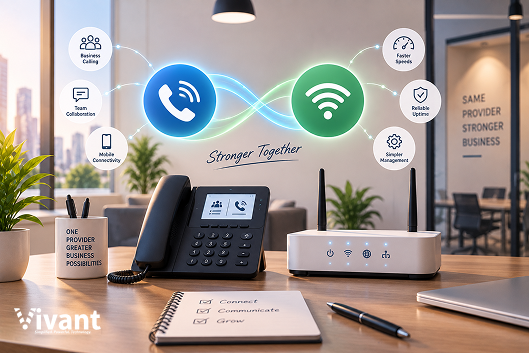
You probably treat phone service and internet like two separate purchases. One vendor sends the internet bill, another sends the phone bill, and when something breaks, you’re left with two support lines to call and two contracts to read before anyone can tell you whose fault it is. That split makes sense on paper, since internet and phone feel like different products. In practice, they aren’t separate at all anymore.
Nearly every modern business phone system runs as VoIP, which means your phone system rides on top of your internet connection instead of using its own dedicated line. That single fact changes the entire calculation. When your internet goes down, your phones usually go down with it, whether or not you realize the two are connected until the moment they stop working together. Business phone and internet bundles exist because internet and phone were never really two products to begin with. They’re one system with two names, and treating them as two vendor relationships is what creates the gaps.
This post walks through what a real phone and internet bundle should include, why bundling is a reliability decision as much as a cost decision, and what that looks like priced out in an actual plan rather than a sales pitch.
The hidden cost of splitting phone and internet across two vendors
When you run separate contracts for internet and phone service, you take on costs that don’t show up as a line item, but they show up everywhere else.
- Two bills to reconcile every month, often on different cycles, from different companies, with different account numbers and different renewal terms.
- Two points of support to call when something goes wrong, and neither vendor is responsible for the other’s part of the system, so you’re left proving whose problem it is before anyone starts fixing it.
- Two contracts with two different end dates, which makes it harder for you to renegotiate, switch providers, and plan for growth across multiple locations.
- No single party accountable for how your phone system and your internet connection actually perform together, since each vendor is only accountable for their own piece.
None of this is a reason to avoid VoIP or cloud phone systems. It’s a reason to stop buying your connection and your phone system from two different companies that have no relationship with each other.
Bundling internet and phone for your business is a reliability strategy, not just a billing convenience
The administrative case for bundling your internet and phone is real, but it’s the smaller half of the argument. The bigger issue is what happens during an outage.
Why an internet outage becomes a phone outage
Because your VoIP phone system depends on your internet connection to function, an internet outage doesn’t just take down web browsing and email. It takes down your phones too. A restaurant that loses internet during a Friday dinner rush doesn’t just lose its point-of-sale connection, it loses the ability to take reservation calls and pickup orders. A dealership that loses internet loses its ability to answer sales calls and service department calls at the same time. A legal or professional office loses client calls entirely, with no warning to the people calling in that anything is wrong.
This is the part you don’t find out until it happens to you: your phone system and your internet connection aren’t two separate points of failure. They’re one point of failure wearing two names. A vendor who only sells internet has no reason to engineer around that, because the phone system isn’t their product. A vendor who only sells phone service has no reason to engineer around that either, because the internet connection isn’t their product. The gap in between is exactly where outages turn into lost calls.
What it takes to actually close that gap
Closing the gap requires your internet connection and your phone system to be engineered together, by the same provider, on purpose. That means dual backup internet that keeps your connection alive when the primary line fails, and Call Deflection that automatically routes calls elsewhere or informs callers during an outage instead of leaving them on a dead line. Neither feature means anything if they’re managed by two vendors who don’t talk to each other. Backup internet that a phone vendor doesn’t know exists won’t get configured to protect your phone system specifically. It will protect general internet traffic and leave call routing as an afterthought, if it’s addressed at all.
How bundling makes redundancy work end to end
Redundancy only works if it covers your whole system, not just part of it. You might think you have redundancy because you have a backup internet line, but if that backup line was set up by an internet-only vendor, it may keep WiFi and point-of-sale running while your phone system still drops, because failover wasn’t configured with the phone system in mind.
When your phone and internet come from the same provider under one contract, backup internet is built to keep your phones alive too, not just general connectivity. That’s the difference between redundancy that looks complete on a diagram and redundancy that actually holds up during a real outage. It also means network redundancy and failover, high availability network design, and priority-level support are managed by one team that understands how your phone system, your internet connection, and your failover path all depend on each other, instead of three separate vendors each managing their own slice.
Why AI receptionist and voice AI ordering only work once the foundation is unified
Add-on capabilities like an AI Receptionist or Voice AI ordering get pitched as standalone upgrades, but they only function as well as the phone system and internet connection underneath them. An AI receptionist that’s supposed to answer every call still needs a phone system that’s actually online, and that phone system still needs an internet connection with real failover behind it. Layering advanced call handling on top of a phone and internet setup that isn’t unified just adds a third thing that can break instead of fixing the first two.
This is why these add-ons make the most sense inside a bundle rather than bolted onto separate vendor relationships. Once your phone system and internet are engineered together and covered by the same redundancy, adding an AI receptionist to handle overflow calls or a voice AI ordering system for a restaurant becomes a genuine capability upgrade rather than one more point of failure sitting on top of two vendors who already don’t coordinate with each other.
What’s actually included in a business phone and internet bundle
It helps to see this priced out rather than described in the abstract. Every Vivant plan bundles phone service and a phone system together with internet under one contract, one bill, and one point of support, and the plans scale with how much redundancy and support your location needs.
Starter, from $350 per month per location
Entry-level internet paired with dual backup internet, plus phone service and a phone system, intrusion detection and prevention, quarterly PCI compliance, network management, and proactive health monitoring. This tier fits smaller locations that still need phone and internet to be reliable together, not just cheap separately.
Business Critical, from $450 per month per location
Vivant’s most popular tier. It builds on Starter with upgraded internet speed, network redundancy and failover, and proactive support and management. This is the tier most restaurants, healthcare offices, professional offices, and home service contractors land on, because it’s built for a location where phone and internet downtime has a direct, immediate cost.
Mission Critical, from $900 per month per location
Primary and secondary business internet, high availability SD-WAN, high availability network, and priority level 2 support. This tier is built for dealership groups and larger multi-location operators where every location’s phone and internet performance needs to be managed consistently and where an outage at one location can’t be allowed to go unnoticed.
Every tier includes phone service and a phone system as part of internet, not as an add-on quoted separately. That’s the structural difference between a bundle and two vendors billing under the same invoice, it’s one engineered system priced as one thing.
Frequently asked questions
Does bundling phone and internet actually save you money compared to buying them separately?
Bundling removes the administrative overhead of managing two vendors, two bills, and two contracts. Vivant’s plans price phone service and a phone system in as part of the internet plan itself rather than as a separate line item, so you’re not paying for the phone system on top of a separate internet bill.
If my internet goes down, will my business phones stop working?
If your phone system is VoIP, which most modern business phone systems are, and your internet and phone aren’t engineered together with backup internet and Call Deflection, an internet outage will likely take your phones down with it. Bundling is what makes it possible to engineer backup internet and call routing around your phone system specifically, rather than leaving that gap unaddressed.
What’s the difference between backup internet under a bundle versus backup internet from my current internet provider?
Backup internet from an internet-only provider is typically built to protect general connectivity, like WiFi and point-of-sale systems. Backup internet as part of a bundled phone and internet plan is engineered with your phone system in mind, so failover keeps your calls connected too, not just the network.
Can I add AI Receptionist or Voice AI ordering later, or do I need it from the start?
These are add-on capabilities on top of your phone system, so they can be added once your underlying phone and internet setup is in place. They work best, however, once your phone system and internet connection are already unified and reliable, since that foundation is what the add-ons depend on to function consistently.
The bottom line
Business phone and internet bundles aren’t a marketing bundle in the sense of two products shrink-wrapped together to look like a deal. They’re a response to a technical reality: VoIP phone systems depend on the internet connection, so treating phone and internet as separate purchases from separate vendors leaves a gap that only shows up when something goes wrong, usually during the outage you can least afford.
Vivant’s plans, from Starter at $350 a month to Business Critical at $450 to Mission Critical at $900, bundle phone service and a phone system into internet at every tier, with backup internet, redundancy, and support engineered to cover both systems together rather than separately. That’s what makes AI Receptionist and Voice AI ordering genuine upgrades instead of one more vendor relationship to manage.
If your business is currently running phone and internet as two separate contracts, it’s worth finding out what a unified plan would actually include. Explore Vivant’s Business Phone System or check current Pricing to see which tier fits your location.
Build infrastructure that keeps the whole stack running.
Get a free cost analysis of bandwidth, segmentation, and failover across your locations.